
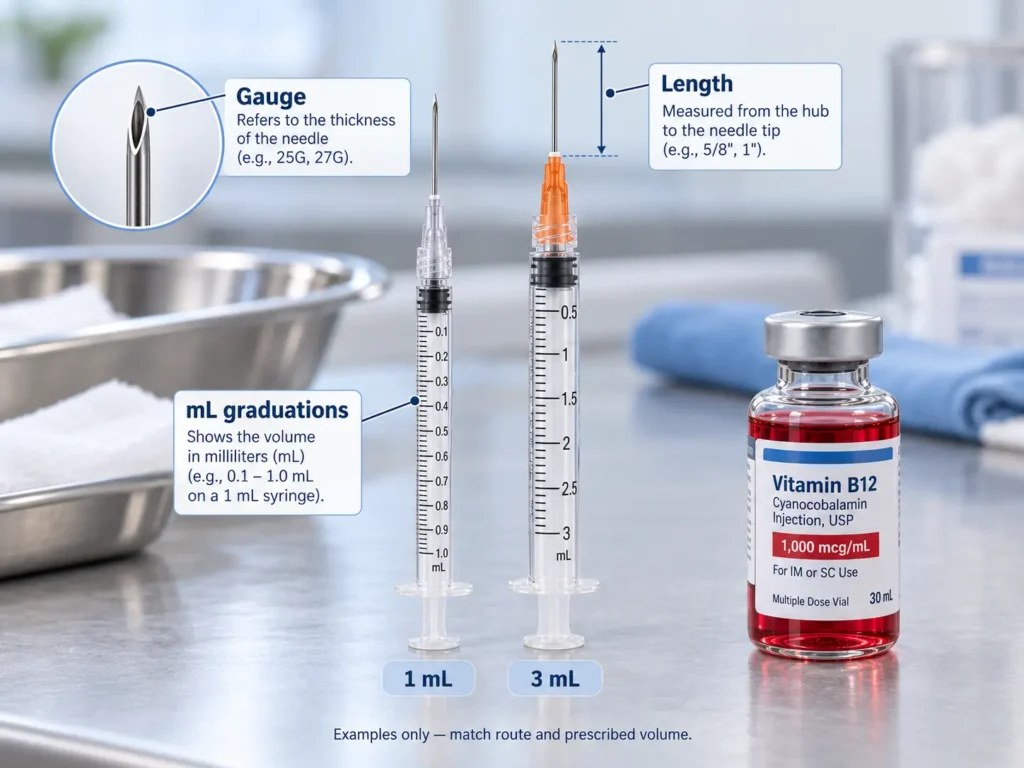
Needle sizes, syringe markings & injection supplies
Match B12 injection supplies to the prescribed route and liquid volume. This guide explains needle gauge, length, syringe markings and the equipment to check before use or purchase.
Assigned reviewers
Use this equipment guide alongside your prescription, the exact product instructions and hands-on training from your healthcare professional. The reference ranges below explain general adult injection equipment; your clinician or pharmacist should confirm your B12 route and supplies.
Quick answer
What size needle and syringe do you need for B12 injections?
B12 needle size depends on the prescribed route, site and individual assessment. General nursing references describe 20–25G for aqueous IM medicines and 25–30G for SC injections.[3][4] These ranges are not a prescription for your injection.
Match syringe capacity and mL markings to the prescribed liquid volume. A 1 mL or 3 mL barrel does not establish the B12 dose; check its actual graduation and needle configuration.
- Check the medicine: exact product, concentration, prescribed route and packaging.
- Check the needle: gauge × length, intended use and connection.
- Check the syringe: capacity, mL or insulin-unit scale, smallest marked increment and sterile packaging.
Is a B12 injection intramuscular or subcutaneous?
It can depend on the specific B12 medicine. The Lifestar cyanocobalamin label reviewed for this article permits intramuscular (IM) or subcutaneous (SC) administration. The reviewed Actavis hydroxocobalamin replacement-product label specifies IM administration only.[1][2] Those statements apply to those products, rather than every formulation sold under the name vitamin B12.
IM means delivery into muscle. SC, also written SQ or subcutaneously, means delivery into the tissue beneath the skin. A needle chosen for one route is not automatically suitable for the other. Even when the label permits both routes, that does not authorize changing the route your healthcare professional prescribed.
Before replacing supplies, compare the medicine label, your written instructions and the equipment you were given. If they disagree, ask the dispensing pharmacy to resolve the difference before use.
B12 injection needle size: how gauge and length work together
A specification such as 25G × 1 inch contains two separate measurements. The first is gauge: a higher gauge number describes a thinner needle. The second is length: 1 inch is approximately 25 mm. Two 25G needles can have different lengths and be intended for different injection workflows.
| Prescribed route | Reference gauge | Reference length | What still needs assessment |
|---|---|---|---|
| Adult IM, aqueous medicine | 20–25G | 5/8–1½ inches, approximately 16–38 mm | Selected site, tissue depth, body composition, medicine and local protocol.[3] |
| SC injection, when prescribed and permitted | 25–30G | 3/8–5/8 inch, approximately 9.5–16 mm | Subcutaneous tissue, selected site, device and the trained technique.[4] |
Swipe the table to view all columns.
Reference ranges vary across teaching resources and protocols. This table is for understanding specifications, not choosing equipment for children or overriding an individualized instruction. The shorter IM lengths shown are not suitable for every adult or injection site.
Where do B12 injection sites fit into the decision?
General IM teaching describes sites such as the deltoid in the upper arm, vastus lateralis in the thigh and ventrogluteal region. SC teaching describes different target tissue and sites.[3][4] Your healthcare professional should identify and demonstrate the site appropriate to your treatment. Choosing the most convenient location does not establish the right needle length.
A higher gauge does not solve every comfort problem
A thinner needle cannot compensate for the wrong length or route. When asking about discomfort, show your clinician the full package specification and describe what happened. Replacing a needle with a shorter one purely for comfort can change which tissue it reaches.
What size syringe is used for B12 injections?
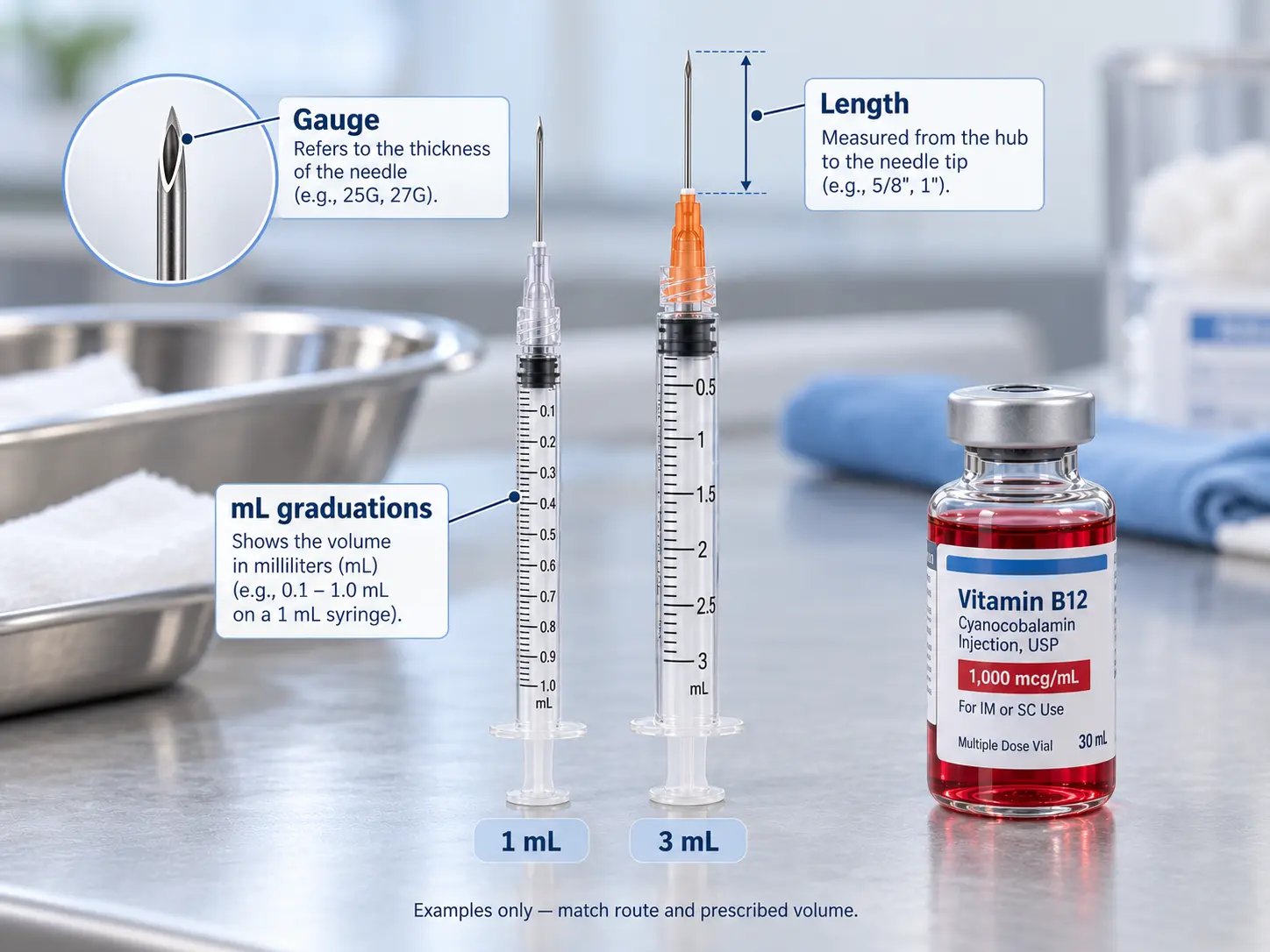
Syringe size is a volume-measurement decision. The syringe must hold the prescribed liquid volume and provide markings that allow it to be measured as instructed. The strength of the medicine, such as mcg/mL, is a separate label field. A 1 mL barrel does not mean every B12 prescription calls for 1 mL.
| Capacity or feature | Reason to consider it | Check before use or purchase |
|---|---|---|
| 1 mL, mL-marked syringe | Small prescribed volumes that fit within its capacity. | Actual graduation, readability, connector and needle arrangement. Not every 1 mL syringe has the same scale. |
| 3 mL syringe | A larger-capacity device when the approved volume and measurement requirement support it. | Ability to read the required volume. A bigger barrel does not make a small volume easier to measure. |
| Luer-lock or other connector | Connection to a specified detachable needle or preparation device. | Manufacturer compatibility and the actual attachment instructions; check each component. |
| Safety mechanism | A device evaluated for the clinical workflow and sharps controls. | Activation instructions, training, handling and disposal requirements. |
Swipe the table to view all columns.
As a concrete scale example, BD lists a 1 mL SafetyGlide tuberculin syringe, REF 305945, with a 0.01 mL graduation and a 27G × ½-inch needle.[5] This illustrates why the precise product record matters. It is not a recommendation to use that needle for an IM B12 injection, and it does not establish the scale of other 1 mL syringes.
B12 services also use configurations outside a simple “1 mL versus 3 mL” comparison. Guy’s and St Thomas’ lists a 2 mL syringe with separate drawing-up and injection needles in its particular home-treatment program for nitrous-oxide-related nerve problems.[9] That is a service-specific example, not a universal B12 kit.
Can you use an insulin syringe for a B12 injection?
Do not substitute one just because it holds the same volume. An insulin syringe may display a concentration-specific insulin-unit scale and have a short fixed needle. Those details can differ from the mL-marked syringe and needle specified for your B12 treatment.
A short needle does not become an IM needle because its barrel holds 1 mL. Equally, a device should not be ruled in or out by its name alone: the pharmacist or clinician must assess the actual scale, needle length, intended route and instructions.
If a pharmacy deliberately selects an insulin syringe for a particular prescription, obtain clear instructions for that exact device. Do not calculate your own conversion from an online chart. Our insulin syringe vs tuberculin syringe comparison explains the differences between capacity, scale and device configuration.
Drawing-up needles, injection needles and glass ampoules
A preparation device transfers medicine into the syringe. The administration needle delivers it to the patient. In workflows that use separate devices, a large drawing-up needle is not a suggestion to inject with that same size.
| Presentation | Preparation question | Supply decision |
|---|---|---|
| Stoppered vial | Which sterile access device does the approved workflow specify? | Match the vial-access and administration components; do not assume a filter is required for every vial. |
| Glass ampoule | Does the institution require an appropriate filter drawing device? | Confirm the filter device, instructions and replacement with the prescribed injection needle. |
| Any supplied kit | Which pieces are for preparation, and which are for injection? | Label and count the components by purpose before approving the kit. |
Swipe the table to view all columns.
BD describes its blunt filter needle as a preparation device for filtering larger particles when drawing from ampoules. Its product information also states that its blunt fill and blunt filter needles are not intended for human injection.[6][10] Follow the selected device’s instructions and the pharmacy’s protocol. “Blunt,” “filter” and “hypodermic injection” are different specifications.
Two easy-to-miss label details
A small vial is not necessarily single-dose. The reviewed cyanocobalamin label lists 1 mL multiple-dose vials. It also describes the medicine as a red solution; “clear” should not be interpreted as colorless. Check appearance against the product label and ask the pharmacist about unexpected changes.[1]
What supplies belong in a B12 injection kit?
Use the written instructions from the treating service as the packing list. The medicine and accessories may be dispensed separately. Before an approved home injection, confirm that the correct supplies, training and disposal arrangements are all available.
| Item | What to confirm | Replenishment rule |
|---|---|---|
| Sterile syringe | Approved capacity, scale, graduation and connector. | A new single-use syringe for each injection. |
| Injection needle | Full gauge × length and approved design. | A new sterile needle for each injection. |
| Drawing-up or filter device | Required only as specified for the medicine packaging and preparation workflow. | Count separately when the workflow uses one. |
| Alcohol preparation supplies | The labeled product and the preparation steps in the instructions. | Count the required tasks; vial and skin preparation may be separate tasks. |
| Gauze or cotton | Materials specified for aftercare. | Replenish against actual planned use. |
| Sharps container | Suitable opening, placement, capacity and disposal route. | Replace when required by its instructions, fill limit or condition. |
| Written instructions | Current medicine, route, equipment and contact details. | Update when the treatment or equipment changes. |
Swipe the table to view all columns.
CDC guidance calls for new sterile needles and syringes and safe vial handling. Changing only the needle does not make a used syringe safe for reuse. Leftover medicine in a single-dose vial should not be retained for a future injection, even for the same patient.[7]
For an opened multi-dose vial, CDC cites a 28-day discard period unless the manufacturer gives a different opened-vial date; that date must not exceed the original expiry.[7] Record the actual product instructions rather than applying one timetable to all B12 presentations.
Arrange sharps disposal before the first injection. FDA advises using appropriate sharps containers and following local disposal rules; its home-use guidance calls for disposal when a container is about three-quarters full.[8] Do not overfill a container or exceed its marked limit. Our sharps container size and placement guide covers facility planning in more detail.
B12 needle and syringe FAQ
Is a 25G needle suitable for a B12 injection?
Gauge alone is not enough to decide. The length, prescribed route, selected site and individual assessment still matter. A 25G × 1-inch needle and a 25G × 5/8-inch needle are different configurations; follow the exact specification your healthcare professional gives you.
Does a B12 shot always need a 1-inch needle?
No. The needle must reach the tissue specified by the prescription. General adult IM references include different lengths according to the person and site; an SC instruction targets different tissue. Do not use a fixed length rule for every B12 injection.[3][4]
Is a 1 mL syringe better than a 3 mL syringe for B12?
Neither is automatically better. Match the prescribed liquid volume, the actual graduation and the approved needle configuration. A larger capacity does not indicate a larger prescribed dose or a more severe deficiency.
Can vitamin B12 be given subcutaneously?
Some cyanocobalamin labels permit SC administration, including the product reviewed here. Other B12 replacement-product labels specify IM administration. Check the exact medicine and follow the route prescribed for you.[1][2]
Can I use a pen needle to draw B12 from a vial?
A pen needle is an accessory for a compatible medication pen. It is not a generic replacement for the syringe and vial-access equipment specified for a B12 vial. Have the pharmacist confirm the correct equipment for the actual medicine presentation.
Can I reuse a syringe if I replace the needle?
No. Use new sterile equipment as instructed for each injection. Replacing the needle does not make a used syringe safe, including for access to medicine containers.[7]
Do B12 injection kits include the medicine?
Check the actual offering. A supply kit may contain accessories only, with the prescription medicine dispensed separately. For a Tonmit accessory inquiry, list the components you need and ask us to confirm the available configuration.
A clinic supply example: count components, not just kits
Suppose a clinic has 120 approved injection appointments in the next ordering period. Its established workflow uses one syringe, one separate drawing-up device and one injection needle per appointment. Before reserves or pack rounding, that means 120 of each component, not 120 needles in total.
If 35 approved injection needles are already usable and available, the net injection-needle requirement is 85 before any agreed reserve. Calculate syringes and preparation devices separately. A workflow with a different device arrangement needs a different count.
This is a hypothetical inventory example. It does not set a B12 treatment schedule, require two needles for every injection or represent a Tonmit customer outcome.
Check the replacement item before accepting a substitution
At Tonmit, we ask buyers to send the approved equipment specification with their inquiry. “B12 needles” is not a complete purchase description. Include the exact gauge and length, syringe capacity and scale, connector, preparation-device requirement, safety design, packaging and destination market.
A receiving check should compare the supplied manufacturer reference, package label, sterile-barrier condition, lot, expiry and pack count with the approved order. If a supplier proposes a different capacity, graduation, needle length or connector, route it back to the responsible clinical or pharmacy team for approval.
For pharmacy & clinic orders
Copyable B12 accessory supply checklist
Use this blank template to request equipment against an existing approved specification. Keep patient names, medical records and personal health information out of the inquiry.
Open the checklist below to select and copy the text manually.
View the blank checklist
B12 accessory supply inquiry
Destination country and delivery location:
Pharmacy, clinic or distributor:
Medicine presentation and packaging, as confirmed by pharmacy:
Prescribed route, already confirmed by the treating team:
Approved syringe capacity:
Scale unit and required graduation:
Approved injection needle gauge x length:
Fixed or detachable needle; connector:
Drawing-up/filter device, if required:
Safety-device requirement and training provision:
Approved reference/SKU or specification document:
Preparation supplies and quantities:
Sharps-container and disposal requirements:
Quantity by component; usable stock already counted:
Units per pack and packs per case:
Required delivery date:
Labeling/documentation requirements for destination market:
Substitution approval contact:
Business contact details:
Work with Tonmit
Send us your approved supply requirements
Tell us the equipment specifications, component quantities and delivery country. We can review the accessory inquiry and confirm available configurations, packaging, documentation and lead time for the requested items.
Sources and scope
U.S. medicine labels are used for the route examples. Nursing resources explain general equipment selection, while the NHS example describes one specific service. Manufacturer specifications apply to the cited product; none establishes a universal B12 needle or endorsement of a Tonmit configuration.
- DailyMed: Lifestar cyanocobalamin injection labeling — routes, solution appearance and vial presentations.
- DailyMed: Actavis hydroxocobalamin injection labeling — product-specific IM route.
- OpenStax Clinical Nursing Skills: intramuscular injections — general gauge, length and site considerations.
- OpenStax Clinical Nursing Skills: subcutaneous injections — general SC equipment references.
- BD SafetyGlide 1 mL tuberculin syringe, REF 305945 — capacity, 0.01 mL scale and attached needle.
- BD blunt fill and blunt filter needle intended uses — preparation devices and injection restrictions.
- CDC: preventing unsafe injection practices — sterile equipment, single-dose and multi-dose vial handling.
- FDA: sharps disposal containers — home-use container and disposal guidance.
- Guy’s and St Thomas’: IM B12 home-treatment equipment — a service-specific supply example.
- BD U.S.: blunt fill and blunt filter needles — ampoule preparation and filtration.
For our authorship roles, evidence checks and corrections process, see the Tonmit editorial standards and team.