
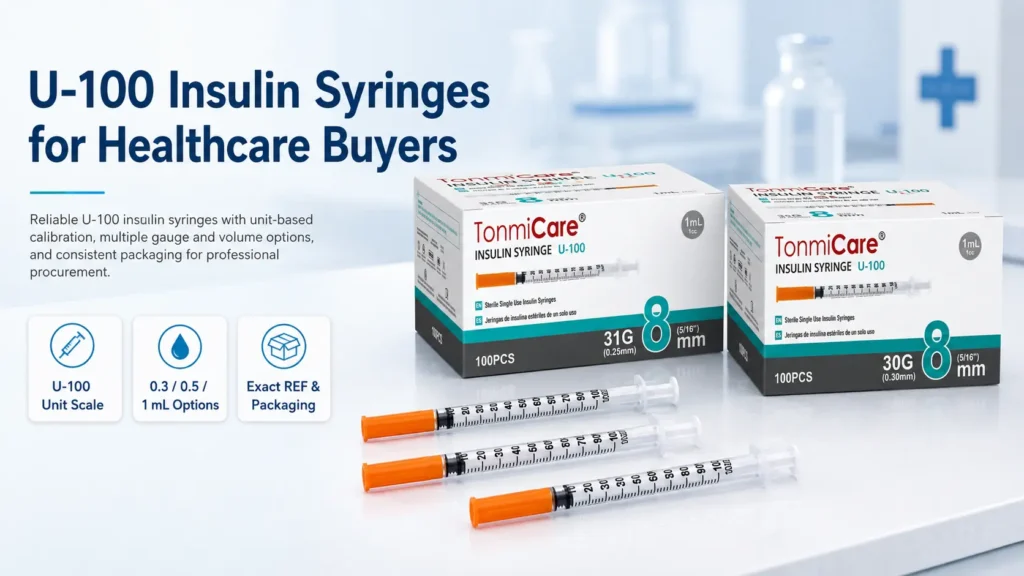
U-100 Scale, SKU Identity & Procurement Controls
Buying a U-100 insulin syringe involves more than choosing a needle size. This guide helps pharmacy, clinic and distribution buyers separate the insulin scale from barrel capacity, check an offered product against the request, and compare the box, case and delivery terms without accepting an unnoticed substitution.
Scope: A purchasing guide for finished insulin syringes, not a dose-conversion chart or individual treatment instruction. Match the prescribed insulin, syringe scale and approved device. Patient-specific decisions remain with the prescription, current labeling and qualified healthcare professional.
Quick answer
What Does U-100 Mean on an Insulin Syringe?
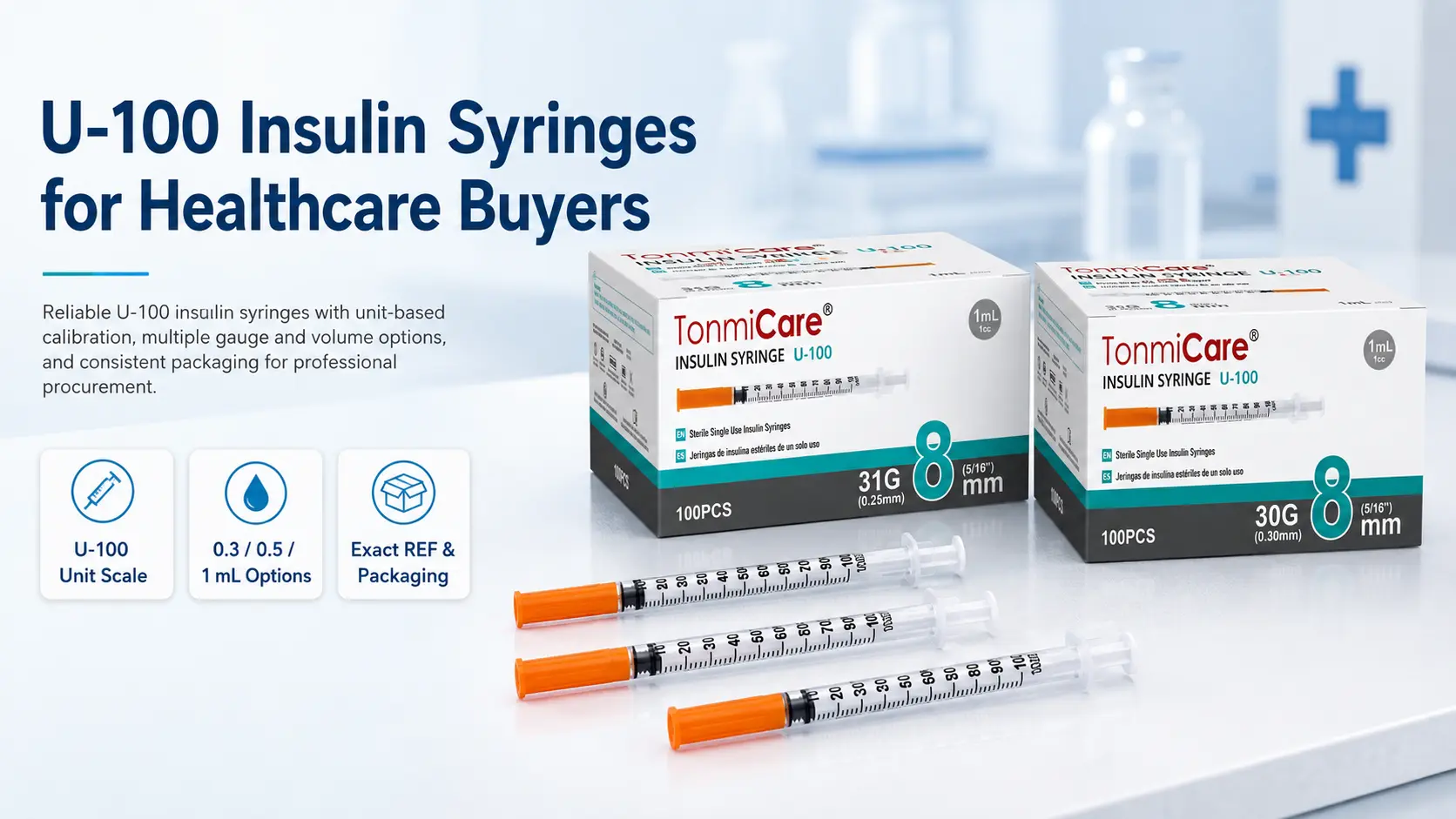
U-100 means the syringe’s insulin-unit scale is intended for insulin labeled 100 units/mL. It does not mean the barrel must hold 1 mL. Common U-100 formats are 0.3 mL with a 30-unit maximum, 0.5 mL with a 50-unit maximum, and 1 mL with a 100-unit maximum. The individual product label controls the actual markings.[1][7]
For ordering, add the barrel capacity, graduation, needle gauge and length, manufacturer reference and pack quantity. Those details decide whether two quotations cover the same product. Check the capacity table or go straight to the copyable RFQ.
Executive summary
Key Takeaways for Healthcare Buyers
- Read three fields separately: U-100 is the scale; 0.3/0.5/1 mL is capacity; the spacing between marks is graduation.
- Compare the offered REF with the requested REF: matching gauge or box count alone is not enough.
- Keep concentration changes out of routine substitution: a different insulin scale is not a purchasing shortcut.
- Check what arrives: reconcile the approved specification with the label, lot, expiry and actual count before stock is released.
1. U-100 Is a Scale Identity, Not a Complete Product Description
On an insulin vial, U-100 identifies a concentration of 100 insulin units per milliliter. On an empty insulin syringe, it identifies the matching unit scale; the syringe does not contain insulin simply because it is labeled U-100. The HUMULIN R prescribing information is one product-label example that identifies the medicine as 100 units/mL (U-100).[7]
Read the scale before the rest of the order line. A familiar cap color, a clear photograph or a matching needle size cannot replace the U-100 marking and manufacturer reference on the approved product.
Procurement rule: Treat “U-100” as a non-substitutable product-identity field. Confirm it before capacity, needle size, packaging or price enters the comparison.
2. What U-100 Does—and Does Not—Tell a Buyer
| U-100 can identify | U-100 cannot identify by itself | Buyer verification |
|---|---|---|
| The concentration system represented by the unit scale | Whether the barrel is 0.3, 0.5 or 1 mL | Confirm nominal volume and maximum marking |
| That the scale is intended to correspond to 100 units/mL insulin | Whether adjacent lines represent half, one, two or another unit interval | Review the exact barrel artwork or controlled drawing |
| A critical concentration field for the approved SKU | Needle gauge, length, wall type or bevel | State gauge × length separately |
| A required catalog, PO and warehouse descriptor | Fixed needle, Luer, safety or other configuration | Verify actual structure and intended use |
| A basis for separating incompatible inventory | Sterility, barrier format, shelf life or latex statement | Request SKU-scoped label and evidence |
| A field that should be protected from substitution | Manufacturer, REF, UDI/GTIN, package quantity or market status | Reconcile the complete identity chain |
3. Is a U-100 Insulin Syringe Always 1 mL?
No. U-100 describes the concentration scale, while milliliters describe physical barrel capacity. The following table is a category-level purchasing snapshot, not a statement that every manufacturer’s markings, needle choices or package counts are identical.
| Nominal barrel capacity | Common U-100 maximum marking | What still requires exact-SKU verification |
|---|---|---|
| 0.3 mL / 0.3 cc | 30 units | Graduation interval, including whether a half-unit option is actually offered |
| 0.5 mL / 0.5 cc | 50 units | Graduation, gauge × length, sterile presentation and package quantity |
| 1 mL / 1 cc | 100 units | Graduation, configuration, intended use, manufacturer REF and packaging |
For a fuller comparison of barrel sizes, unit capacities, gauge and needle length, use Tonmit’s guide to compare 0.3 mL, 0.5 mL and 1 mL insulin syringe sizes. This article intentionally keeps the size discussion short so the U-100 page remains focused on identity and procurement control.
Two terms that buyers should not merge
U-100 insulin syringe identifies a concentration-calibrated syringe category. 100-unit insulin syringe usually points to the maximum marking of a 1 mL U-100 format. Search queries may use the phrases interchangeably, but purchase records should not.
4. How to Decode a Complete U-100 Insulin Syringe SKU
Start with the requested device, not the shortest catalog description. A usable quotation line looks like this:
U-100 scale | 0.5 mL / 50-unit maximum | [verified graduation] | 31G
          × 8 mm | fixed needle | sterile single-use | [primary pack] | 100/box
          | [boxes]/case | manufacturer REF [____] | UDI/GTIN [____] | label
          revision [____]
This is an example of the fields to collect, not a Tonmit SKU specification. Replace the bracketed entries with the supplier’s documents. Keep the request, offered product and received product in separate columns so that a difference remains visible. Our wholesale insulin syringe page is the next step for configuration and supply review.
Worked purchasing example
Both quotes say U-100. Are they the same order?
Suppose a purchase request specifies a 0.5 mL U-100 syringe with a fixed 31G × 8 mm needle. The offered box also says U-100 and 31G × 8 mm, but the barrel is 1 mL. The scale and needle match; the capacity does not.
| Check | Requested | Offered |
|---|---|---|
| Scale | U-100 | U-100 |
| Needle | Fixed, 31G × 8 mm | Fixed, 31G × 8 mm |
| Capacity / maximum | 0.5 mL / 50 units | 1 mL / 100 units |
| Graduation and REF | Approved requirement | Must be checked separately |
Decision: mark the offer as a proposed alternative, not an exact match. Ask for the correct product or route the difference for authorization before ordering. No dose conversion is involved in this check.
Illustrative scenario, not a customer case, test result or statement of current availability.
5. Why Graduation Must Be Verified by Exact REF
Capacity and graduation answer different questions. Capacity establishes how much the barrel can contain; graduation establishes what the interval between adjacent scale lines represents. A catalog may contain several U-100 products that share capacity but differ in graduation, needle dimensions or safety configuration.
The BD SafetyGlide overview gives a useful, specific example: catalog number 328449 is listed as a 0.3 mL, 31G × 6 mm syringe with half-unit markings. The same overview lists other barrel capacities under different catalog numbers.[1] This shows how to verify a graduation claim by reference; it is not evidence that every 0.3 mL syringe, or a Tonmit product, has those markings.
- Request the exact REF and current controlled product specification.
- Review a clear barrel-scale image or engineering artwork.
- Confirm the maximum marking and adjacent-line interval separately.
- Match the approved sample to the quote and packaging label.
- Record whether a special graduation is mandatory or merely preferred.
- Reject substitutions that change graduation without written approval.
Do not state “all 1 mL U-100 syringes use two-unit graduations” or “all 0.3 mL syringes use half-unit markings.” Those claims are too broad for SKU-controlled procurement.
6. U-100 vs U-40 and U-500: Prevent Cross-Concentration Substitution
U-40, U-100 and U-500 identify different concentration systems. Similar needle dimensions do not make their administration devices interchangeable. The current HUMULIN R U-500 prescribing information, revised July 2026, describes a prefilled KwikPen and explicitly prohibits transferring insulin from that pen into any syringe.[2] A historical syringe announcement is not a substitute for checking today’s labeled presentation.
For procurement, confirm the medicine presentation and the device specified by its current labeling. Do not solve a shortage by changing concentration scales or drawing from a pen with a U-100 syringe. The U-40 versus U-100 guide covers the separate inventory controls; this page does not provide conversion instructions.
Do not turn a purchasing guide into a conversion chart
This article intentionally does not provide U-40/U-100/U-500 dose-conversion tables. Mathematical conversion does not remove the selection, labeling, communication and administration risks created by a mismatched device.
Copy-ready PO control:
No substitution of concentration scale, barrel capacity, maximum unit marking, graduation interval, needle gauge, needle length, product configuration, legal manufacturer, manufacturing site, REF, sterile presentation, label, identifier or packaging revision without the buyer’s prior written approval.
7. Fixed-Needle, Safety and Luer Configurations Are Separate Decisions
“U-100” does not establish how the needle or connection is configured. Many familiar retail insulin syringes use an attached fixed needle, but safety insulin syringes have an actual protective mechanism and Luer configurations serve different connection and use pathways. A standard fixed-needle product must not be marketed as a safety syringe simply because it has a needle cap.
A documented example is Cardinal Health’s September 2024 recall communication for certain Monoject U-100 1 mL Luer-Lock syringe lots. The FDA notice concerns incompatibility with needleless IV connectors.[3] The purchasing lesson is limited but useful: the configuration, product code and lot matter. This is not a recall of all U-100 syringes or of Tonmit fixed-needle products.
| Configuration field | Do not infer from | Required buyer evidence |
|---|---|---|
| Fixed needle | Product-family name or image angle | Specification, label and physical sample |
| Safety feature | Needle cap, orange shield or the word “secure” | Actual protective mechanism and applicable records |
| Luer connection | 1 mL capacity alone | Tip type, connection compatibility and intended-use information |
| Low dead space | Fixed needle alone | Defined design and applicable technical evidence |
| Latex statement | Clear barrel or packaging appearance | Current SKU-specific material statement |
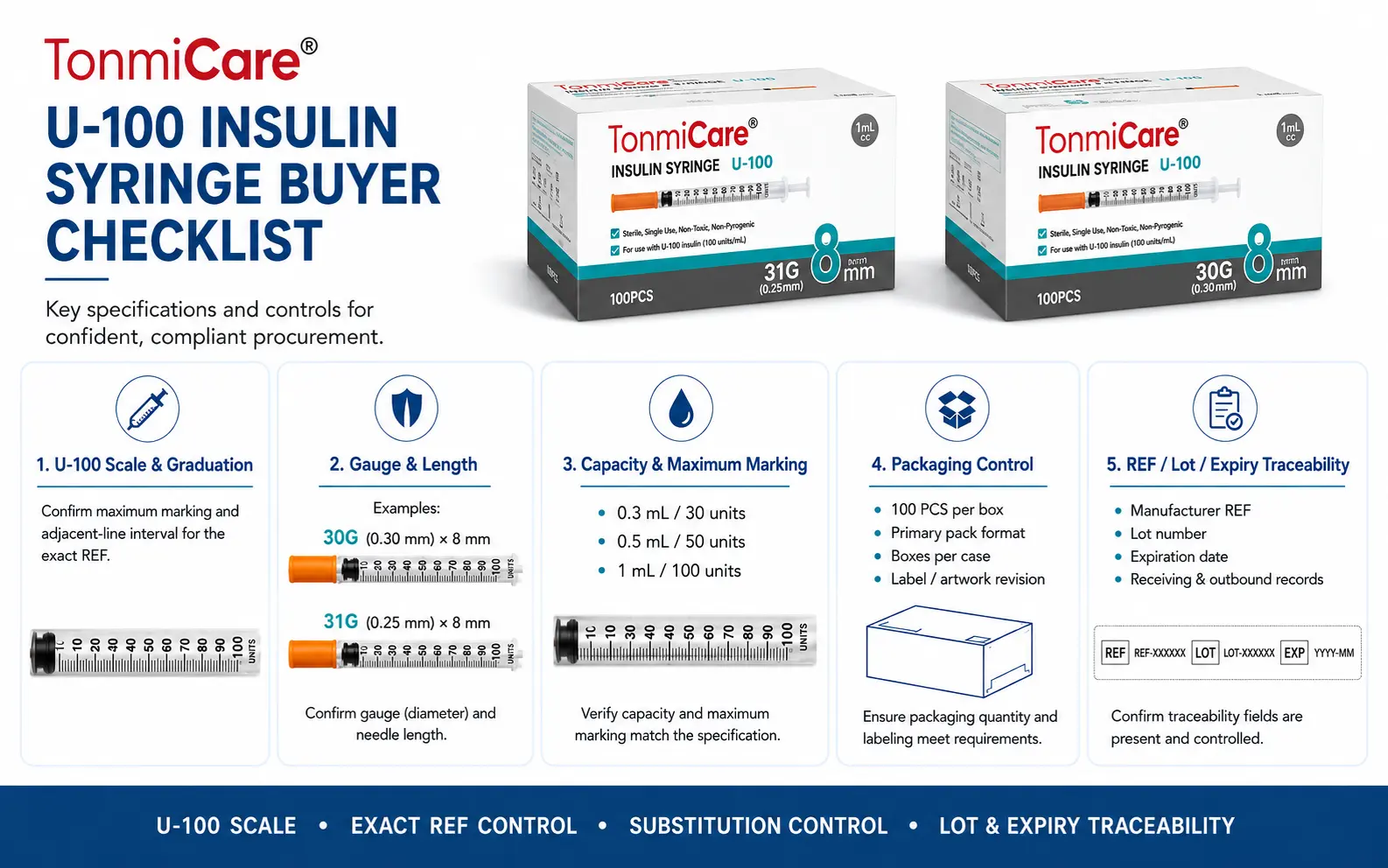
8. Put U-100 Into Catalog, PO and Warehouse Controls
U-100 should be visible wherever staff make a selection, substitution, receiving or traceability decision. Hiding the scale in a long description while the short title reads only “insulin syringe 31G” creates avoidable ambiguity.
Master specification and sample
PO with no-substitution rule
REF, lot, expiry and count
Separated and labeled inventory
Outbound orders and monitoring
| Record or location | Minimum U-100 control | Common failure |
|---|---|---|
| RFQ and quotation | Scale plus the complete requested or offered REF | Supplier quotes an “equivalent” family without differences |
| Approved specification | Scale, capacity, graduation, needle, configuration and pack | Only a catalog screenshot is approved |
| ERP/catalog title | U-100, capacity, gauge × length, manufacturer and REF | Title shows only gauge or box count |
| Purchase order | Exact identifiers, revision, quantities and substitution restriction | PO uses a generic free-text description |
| Warehouse location | Concentration-visible bin label and separated stock | Similar packages share an ambiguous pick face |
| Receiving record | REF, label revision, lot, expiration and accepted quantity | Only case quantity is recorded |
| Complaint or recall file | Lot-to-location and lot-to-customer traceability | Affected outbound orders cannot be identified quickly |
When a delivery should go on hold
A different lot is not automatically a different product. A different scale, capacity, graduation or unapproved REF is a different question. Keep the affected quantity identifiable while the responsible reviewer resolves the mismatch.
Identity mismatch: compare the actual label with the approved REF and order.
Quantity mismatch: count in pieces, boxes and cases before recording a shortage.
Damage or short dating: segregate the affected stock and apply the agreed acceptance terms.
Tonmit buyer worksheet
U-100 Receiving & Exception Record
A blank record for the requested product, received lot, discrepancy and release decision. It supports document and visual receiving checks; it does not establish sterility or replace the site’s release procedure.
View the complete template
U-100 INSULIN SYRINGE RECEIVING AND EXCEPTION RECORD
Blank buyer worksheet - one record per REF / lot combination

RECEIPT
Purchase order / delivery reference:
Date received:
Storage location:
Receiver:

APPROVED PRODUCT
Legal manufacturer / labeler:
Manufacturer REF / buyer SKU:
Scale: U-100
Barrel capacity / maximum unit marking:
Smallest printed graduation:
Gauge x needle length:
Fixed needle / safety / other approved configuration:
Approved label or specification revision:
Primary pack / pieces per box / boxes per case:
Minimum remaining shelf life:

RECEIVED PRODUCT - RECORD THE LABEL, NOT THE ASSUMPTION
Manufacturer / labeler:
REF / buyer SKU:
Scale / capacity / maximum marking:
Graduation / gauge x length / configuration:
Label or packaging revision:
UDI / GTIN and package level, where applicable:
Lot / batch:
Expiry:
Quantity received (state pieces, boxes or cases):
Primary pack and box/case counts:
Visible sterile-barrier or shipping damage:
Evidence / photograph reference (no patient identifiers):

EXCEPTION REVIEW
Difference from approved product:
Affected quantity and stock location:
Action: HOLD / QUARANTINE / RELEASE / REJECT / AUTHORIZED CHANGE
Responsible reviewer / date:
Written approval or corrective-action reference:
Final accepted quantity:

METHOD AND LIMITS
Compare order/specification records with the received label, packaging and visible condition.
Follow the site's approved sampling and release procedure; do not open sterile barriers merely
for visual comparison. This blank worksheet is not a completed Tonmit QC record, laboratory
test, regulatory certificate, proof of sterility or a patient-specific selection tool.
9. Verify U-100 Product Claims With Evidence, Not Catalog Language
Ask for the document that resolves the open question. A barrel drawing helps verify graduation; a carton label helps verify pack count; a lot-specific response helps verify dating. Request product documentation for the offered REF, rather than a folder of certificates that may describe another device.
| Supplier statement | Evidence to request | Do not accept as a substitute |
|---|---|---|
| U-100 scale | Current label, barrel artwork, specification and exact REF | A generic family photo |
| Half-unit markings | Controlled scale drawing and approved sample | Assumption based on 0.3 mL capacity |
| Sterile | SKU label, sterile-barrier specification and applicable process records | A certificate for a different product or site |
| Safety syringe | Actual safety mechanism and applicable product record | A protective cap on a non-safety syringe |
| Latex-related claim | Current material statement tied to the SKU | Packaging color or an unrelated brochure |
| Shelf life | Applicable labeling and shelf-life basis for the product and pack | A uniform promise across all SKUs |
| U.S. inventory | Available REF, lot, expiration, releasable quantity and status date | Warehouse address alone |
| 100 per box | Unit-to-box-to-case hierarchy in quote and labels | A retail-box image without master-case data |
10. Box, Case, Shelf-Life and Landed-Cost Controls
“100 syringes per box” does not establish how many boxes are in a case, whether units are bagged or individually presented, or how freight should be compared. Record each packaging level and calculate commercial terms against the accepted-syringe count.
Case quantity = syringes per box × boxes per case
Accepted-syringe cost = total landed program cost ÷ syringes accepted after receiving inspection
Usable inventory horizon depends on remaining shelf life at receipt, expected demand, replenishment time and the buyer’s inventory policy.
Total landed program cost can include product, packaging, freight, duty, brokerage, warehousing, domestic delivery, inspection, rejected goods, shortage management and administrative work. Use the guide to calculate insulin syringe case quantities and landed cost after locking the exact U-100 SKU.
Private-label programs introduce additional artwork, identifier, role and change-control questions. Buyers considering branded packaging should separately review private-label insulin syringe requirements rather than treating a logo change as a purely graphic task.
Illustrative commercial check
A cheaper case can cost more per syringe
Assume both offers cover the same approved device and every unit is accepted. The figures below are invented to show the calculation, not Tonmit prices or packing commitments.
| Offer | Case contents | Product price | Per syringe |
|---|---|---|---|
| A | 20 boxes × 100 = 2,000 | USD 180 / case | USD 0.090 |
| B | 36 boxes × 100 = 3,600 | USD 252 / case | USD 0.070 |
Offer A has the lower case price; Offer B has the lower product-only unit price. Neither is a final purchasing verdict. Add freight and other relevant costs, then check order multiples, remaining shelf life and whether the quantity fits actual demand.
11. Regulatory and Quality Documentation Must Match the Exact Product
FDA states that it does not issue registration certificates to medical-device facilities and that registration and listing do not by themselves denote approval, clearance or authorization.[4] For U.S. procurement, a screenshot headed “FDA registered” is therefore not a complete product review.
For example, FDA’s FMF classification entry describes piston syringes under 21 CFR 880.5860, with Class II and a 510(k) submission type.[5] That database entry is a starting point, not a classification determination for every product carrying U-100 on its label. Separately, FDA’s QMSR took effect on February 2, 2026 and incorporates ISO 13485:2016 by reference.[6] A quality-system statement still does not establish the markings or performance of an individual REF.
A buyer’s documentation matrix may therefore include the legal manufacturer and site, product classification, applicable premarket record, establishment and listing information, UDI/GUDID information where applicable, current U.S. labeling, quality-system scope, sterile-product evidence, shelf-life information, change control and lot traceability. Applicability must be determined for the exact SKU, entities, market and transaction.
Record the relationship, not merely the document name
For each item, record the organization named, site, product or model scope, REF relationship, version or validity date, reviewer, public database search date and unresolved mismatch. A current document for the wrong product is still the wrong evidence.
12. U.S. Inventory and Replenishment Questions
A U.S. warehouse can support faster replenishment, but location alone does not prove that the approved REF is available, released, within the required shelf-life window or traceable. Ask for a dated availability response for the exact SKU.
- Which exact manufacturer REF and package revision are currently available?
- What quantity is released and allocable rather than merely inbound?
- Which lots and expiration dates would be supplied?
- What minimum remaining shelf life will be guaranteed at receipt?
- Can inventory be reserved, and for how long?
- What are domestic dispatch time, freight terms and delivery scope?
- What is the replenishment plan when local inventory falls below the reorder point?
- How are backorders, partial shipments and substitutions communicated?
- Can affected lots be located across stored and shipped inventory?
Tonmit’s U.S.-warehouse-supported fulfillment overview explains how availability, replenishment and domestic coordination should be reviewed as a supply program. For a broader vendor decision, use the framework to evaluate a wholesale insulin syringe supplier.
13. Copyable U-100 Insulin Syringe RFQ
Send the same field structure to every candidate. If a field is undecided, mark it “buyer review required” instead of allowing the supplier to silently choose.
Tonmit buyer worksheet
U-100 Specification & Supply RFQ
Send the same requirements to each supplier. Ask them to list deviations explicitly; do not accept an unspecified substitute just because the quote also says U-100.
View the complete template
U-100 INSULIN SYRINGE SPECIFICATION AND SUPPLY RFQ

Buyer / company:
Destination country and postal code:
Initial quantity / recurring demand:
Required delivery window:

REQUESTED DEVICE
Insulin scale: U-100
Capacity and maximum marking:
Graduation interval:
Needle gauge x exact length (mm / labeled inch value):
Fixed needle / verified safety / other approved configuration:
Primary sterile presentation and material statements:
Legal manufacturer / manufacturing site, if specified:
Manufacturer REF / brand SKU, if specified:
Label / artwork revision:
UDI / GTIN and applicable package level:

PACK AND DOCUMENTS
Pieces per primary pack:
Pieces per sales box:
Boxes per case:
Case dimensions and weight:
Current product specification and labels:
Applicable product-level regulatory and quality records:
Sterile-product and shelf-life documentation:
Lot/expiry format and traceability records:
Production-equivalent sample requirement:

QUOTE AND FULFILLMENT
Unit, box and case price:
MOQ and order multiple:
Freight basis / Incoterm / destination charges:
Current available REF, lot, expiry and allocable quantity:
Minimum remaining shelf life at receipt:
Production, dispatch and transit assumptions:
Partial-shipment and replenishment terms:
Private-label or artwork requirement, if any:

SUBSTITUTION
List every difference between the requested and offered configuration.
No change to controlled product or pack fields without prior written buyer approval.
Leave undecided fields marked 'buyer review required'; do not infer them from U-100 alone.

Do not include patient details or use this RFQ to calculate a dose.
14. Frequently Asked Questions
What does U-100 mean on an insulin syringe?
U-100 means the barrel’s insulin-unit scale corresponds to insulin labeled at 100 units per milliliter. It identifies the concentration scale, not every other syringe specification.
Is a U-100 insulin syringe always 1 mL?
No. Common U-100 categories include 0.3 mL, 0.5 mL and 1 mL. Capacity and concentration scale must be recorded as separate product fields.
Does U-100 mean the syringe holds 100 units?
Not necessarily. A 1 mL U-100 format commonly has a 100-unit maximum, while common 0.3 mL and 0.5 mL U-100 categories have 30-unit and 50-unit maximum markings.
Is 1 cc the same volume as 1 mL?
Yes, 1 cc and 1 mL express the same volume. That volume equivalence does not identify the insulin concentration scale, graduation or exact syringe SKU.
Does every U-100 syringe use the same graduation?
No. Graduation must be verified from the exact REF, controlled scale drawing, current label and sample. Do not generalize a graduation from capacity alone.
Can gauge identify whether a syringe is U-100?
No. Gauge describes relative needle diameter. The same gauge and length may appear on different capacities, concentration scales and configurations.
Can U-40, U-100 and U-500 syringes be substituted?
They should not be treated as interchangeable. Supply the concentration-matched device required by current labeling, prescriptions, organizational approval and qualified professional directions.
What should be included in a wholesale U-100 insulin syringe RFQ?
Include scale, capacity, maximum marking, graduation, gauge × length, configuration, sterile presentation, manufacturer and REF, identifiers, package hierarchy, required documents, shelf-life requirement, quantity, destination, commercial terms and a no-substitution rule.
What should buyers check when a bulk order arrives?
Verify the manufacturer, REF, U-100 label, capacity, graduation, gauge × length, configuration, pack revision, quantity, lot, expiration, sterile-barrier condition and required transaction records against the approved PO.
15. From “U-100 Syringes” to a Controlled Purchasing Specification
U-100 is simple to define but incomplete as a purchasing description. It identifies the insulin concentration system represented by the barrel scale; it does not establish capacity, graduation, needle, configuration, package, evidence or supply terms.
The useful procurement outcome is a controlled identity chain:
U-100 scale → capacity and maximum marking → graduation → needle and configuration → legal manufacturer and REF → label and package revision → lot and expiration → approved supply terms.
Once that chain is fixed, healthcare buyers can compare bulk U-100 insulin syringe supply, case economics, documentation and replenishment without allowing price or appearance to conceal a product difference.
Sources & Editorial Basis
- embecta / BD. BD SafetyGlide insulin syringe product overview. 2023 overview; page 2 identifies 328449 as a 0.3 mL half-unit-scale example. Not a Tonmit specification.
- Eli Lilly and Company. HUMULIN R U-500 prescribing information. Revised July 2026; sections 2.1 and 2.3 describe the KwikPen presentation and prohibit transfer into a syringe.
- U.S. Food and Drug Administration. Monoject U-100 Luer-Lock syringe recall notice. Historical, configuration- and lot-specific example; the notice describes the September 25, 2024 customer communication.
- U.S. Food and Drug Administration. Important Reminders about Registration and Listing. Registration and listing are not, by themselves, product approval, clearance or authorization.
- U.S. Food and Drug Administration. Product Classification: Syringe, Piston (FMF). Product-code entry; check the pathway applicable to the exact offered device.
- U.S. Food and Drug Administration. Quality Management System Regulation (QMSR). Effective February 2, 2026; scope is quality-system requirements, not proof of individual product claims.
- Eli Lilly and Company. HUMULIN R prescribing information. Sections 3 and 16.1 identify 100 units/mL (U-100). Cited for concentration terminology, not treatment selection.
Source check: September 28, 2026. Manufacturer examples and the recall notice apply to the identified products, not every U-100 syringe. Recheck current labels and records when approving an order.
Prepared by the Tonmit Medical Supply Editorial Team and reviewed by James Wilson (Product Specification Reviewer), Michael Thompson (Quality Documentation Reviewer) and David Anderson (Regulatory Research Reviewer). Reviewer profiles, responsibilities and the editorial process are published on the Editorial Team page.
This update adds a quotation mismatch example, a case-price calculation and blank receiving/RFQ tools. The examples are illustrative, not customer outcomes or completed QC reports.
Specification & supply review
Request a U-100 Insulin Syringe SKU Review
Send your required capacity, graduation, gauge × length, pack count, order quantity and destination. We will use those details to review available configurations and the applicable document set before discussing bulk supply.
Price, stock, documents and delivery scope are confirmed for the quoted configuration. The request is a commercial specification review, not a patient-specific recommendation.