
Insulin Syringe Specification & Procurement Guide
An evidence-bounded guide for pharmacies, clinics and medical distributors evaluating low dead space insulin syringes—covering residual-volume terminology, fixed and detachable designs, exact-SKU evidence, regulatory records, substitution control, case purchasing and receiving inspection.
Scope: This guide supports professional purchasing, formulary review and supplier qualification for finished insulin syringes. It does not select a syringe for an individual, replace a prescription or product labeling, teach injection technique, authorize substitution, or provide medication-dose calculations. Buyers and healthcare professionals must verify the prescribed insulin concentration, exact device, current labeling, applicable law and institutional policy.
Direct answer
What Should Healthcare Buyers Verify About Low Dead Space Insulin Syringes?
A low dead space insulin syringe is designed to reduce the fluid remaining in the syringe-and-needle pathway after the plunger is fully depressed. The term does not mean that residual volume is literally zero, and it does not by itself establish dose accuracy, graduation accuracy, clinical superiority or a guaranteed number of additional withdrawals from a vial.
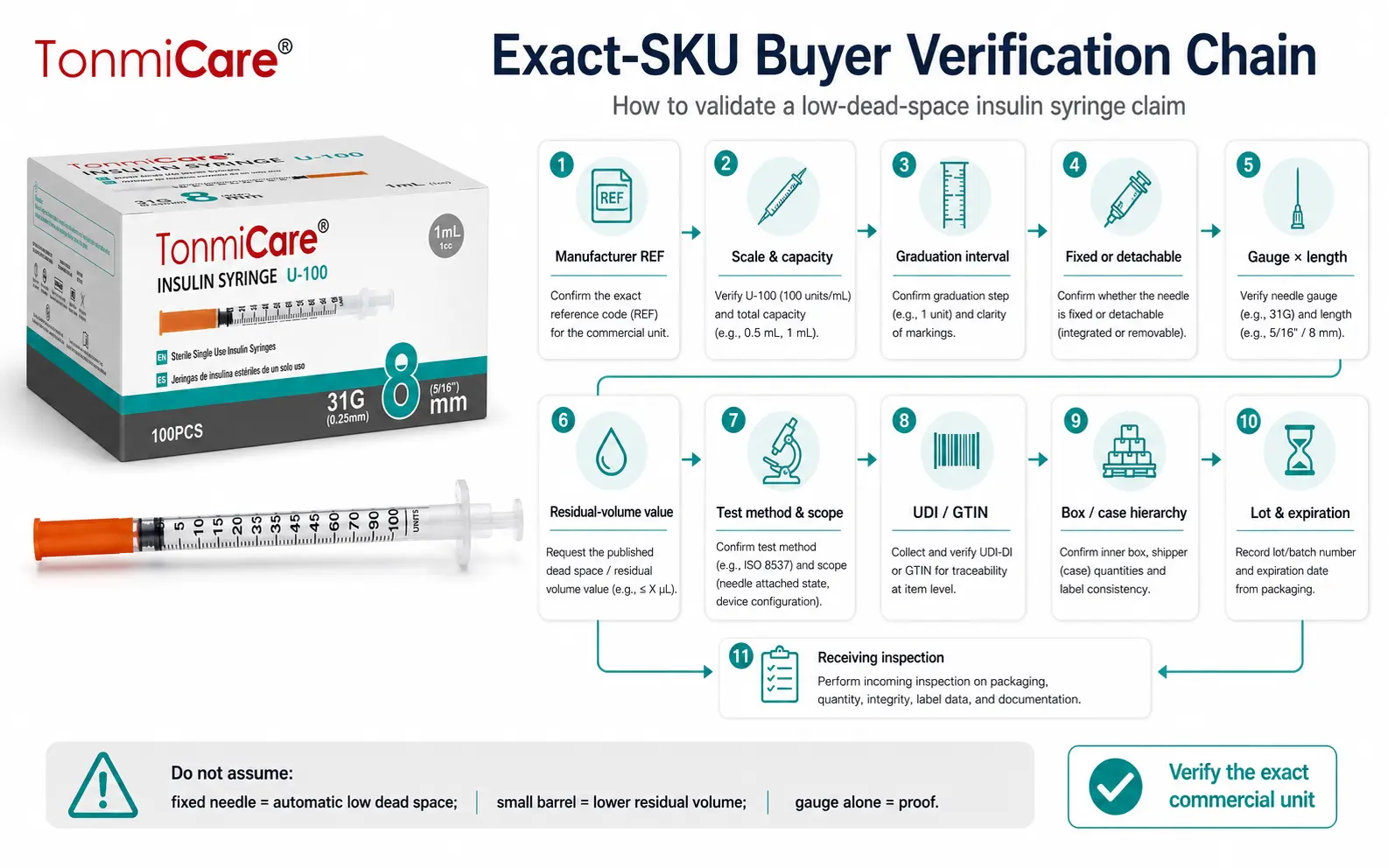
Before approving a product, verify the exact manufacturer REF, insulin concentration scale, barrel capacity, graduation interval, fixed or detachable needle configuration, needle gauge and length, manufacturer-stated residual volume, unit of measurement, test method and tested configuration. Then match that evidence to the sterile package, UDI or GTIN where applicable, FDA record, box and case hierarchy, lot, expiration date and permitted substitution rules.
Terminology
1. Define Dead Space and Residual Volume Before Comparing Products
In practical procurement language, dead space refers to the internal fluid pathway from which liquid cannot be expelled after the plunger reaches its intended end position. Depending on the design, that pathway may include part of the syringe tip, a needle hub and the needle lumen. Residual volume is the measured liquid that remains after a specified filling and expulsion procedure.
The two terms are often used interchangeably in commercial material, but a purchasing specification should state the actual measurable requirement. A supplier statement such as “minimal waste” is not enough. The buyer needs a numerical value or acceptance limit, a unit, a method, a product identity and an explanation of whether the test includes the needle.
Dead space
The internal space that may retain fluid after full plunger depression.
Residual volume
The retained quantity measured under a defined test procedure.
Low dead space
A design or performance claim that must be tied to the exact device evidence.
All fluid pathways require product-specific evaluation. “Low,” “reduced” and “zero” are not interchangeable descriptions, and a visual inspection cannot quantify the retained volume.
Architecture review
2. Compare the Complete Syringe-and-Needle Configuration
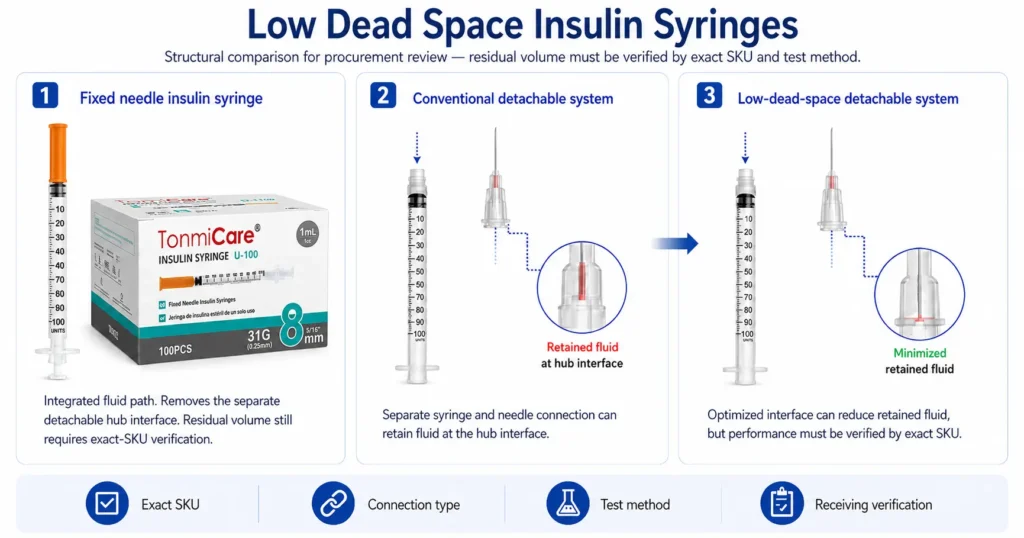
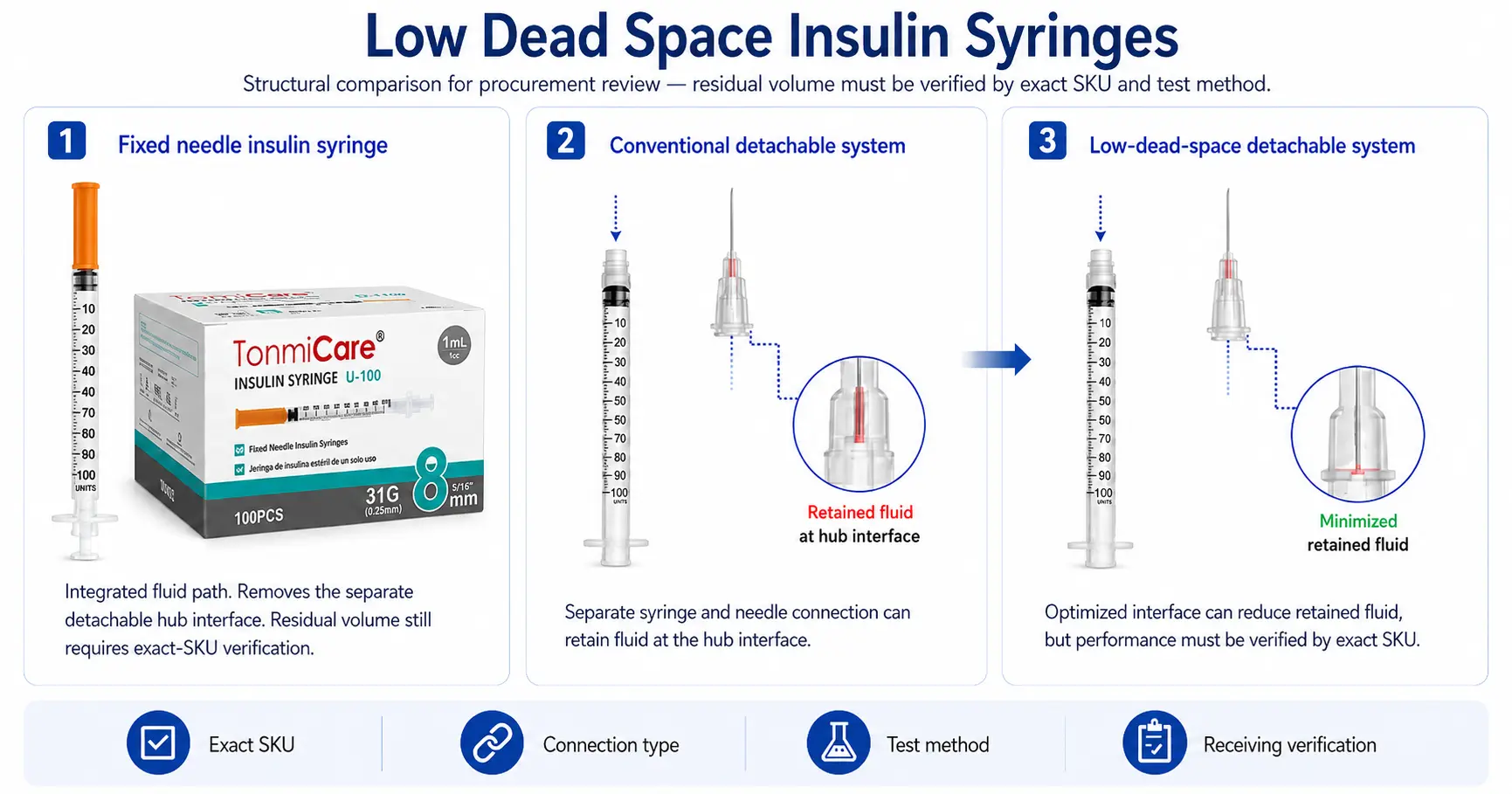
Low residual volume can be pursued through more than one engineering approach. An integrated needle can remove the large detachable hub interface. A detachable syringe may use an extended plunger that reaches farther into the syringe tip. A detachable needle may reduce internal hub volume. These approaches should not be treated as equivalent without testing the complete configuration.
| Configuration | Potential retained-fluid locations | What the buyer should verify | What cannot be assumed |
|---|---|---|---|
| Fixed or integrated needle | Integrated fluid path and needle lumen | Exact REF, capacity, scale, graduation, gauge × length and measured residual volume | That every fixed-needle SKU has the same residual volume |
| Conventional detachable needle | Syringe tip, needle hub and needle lumen | The exact syringe and needle tested together | That connection type alone predicts a specific value |
| Low-dead-space detachable syringe | Reduced syringe-tip space plus the selected needle | Compatible needle, extended-plunger geometry and combined test result | That the syringe-only value applies to every attached needle |
| Low-dead-space detachable needle | Reduced hub volume plus the syringe-tip space | Needle REF, compatible syringe and tested combination | That the needle converts every syringe into the same LDS system |
| Safety-engineered syringe | Depends on fixed, retracting or shielded architecture | Residual-volume evidence and safety-feature operation as separate requirements | That a safety mechanism automatically proves low dead space |
Common buyer question
3. Does a Fixed Needle Automatically Mean Low Dead Space?
No. A fixed needle commonly removes the separate needle-hub connection found in many detachable systems and can reduce one source of retained volume. Published measurements have found lower average dead-space values for the tested fixed-needle configurations than for many tested detachable combinations.[6] That supports an architectural comparison; it does not establish a universal value for every insulin syringe.
A fixed needle remains only one field in the specification. Needle lumen, internal geometry, plunger design, manufacturing tolerances and the test procedure can affect the measured result. Buyers should therefore use wording such as “fixed-needle, low-dead-space configuration supported by exact-SKU evidence,” rather than using “fixed needle” as the complete proof.
Controlled wording
“Please provide the residual-volume specification and test method for manufacturer REF ______, including the fixed needle.”
Uncontrolled wording
“All fixed-needle insulin syringes have nearly zero dead space.”
Performance boundaries
4. Keep Residual Volume, Dose Accuracy and Graduations Separate
Residual volume describes retained liquid. Delivered-volume accuracy evaluates output under defined conditions. Graduation describes the printed scale. Capacity states the maximum nominal barrel volume. These are related procurement fields, but none is a substitute for the others.
| Measure | Buyer question | Required evidence | Incorrect shortcut |
|---|---|---|---|
| Residual volume | How much fluid remains after the defined expulsion procedure? | Value or limit, unit, method and tested configuration | “Low residual volume proves dose accuracy.” |
| Delivered-volume accuracy | Does output meet the applicable acceptance criteria? | Applicable standard or validation for the device family | “Clear markings prove accurate delivery.” |
| Graduation interval | What quantity does each line represent for the labeled scale? | Approved scale drawing, label and physical sample | “Every 0.3 mL syringe has half-unit marks.” |
| Nominal capacity | Is the barrel 0.3, 0.5 or 1 mL? | Exact REF and product specification | “A smaller barrel is automatically lower dead space.” |
Experimental work in another small-volume injection setting found that syringe capacity and low-dead-space design affected accuracy, precision and output differently.[7] The study should not be used to claim insulin performance for an untested SKU; it illustrates why the buyer must request each measure separately.
Supplier qualification
5. Evidence Healthcare Buyers Should Request
A product brochure may introduce the design, but it should not be the final evidence package. Ask the supplier to connect each claim to the legal manufacturer, exact model and current commercial unit.
Exact identityLegal manufacturer, labeler, brand, product name and manufacturer REF.
Complete syringe specificationConcentration scale, capacity, graduation, needle fixation, gauge and length.
Residual-volume statementNumerical value or limit in µL or mL, not only “minimal waste.”
Test scopeWhether the value includes the needle and which components were assembled.
Test methodReferenced standard or controlled internal method, sample definition and acceptance criterion where available.
Commercial-unit matchApproved label, IFU where applicable, UDI/GTIN, sterile package and pack hierarchy.
Availability varies by manufacturer and project stage. A buyer may receive a specification, declaration, test summary or controlled report rather than unrestricted access to a confidential validation file. Record what was reviewed, the exact product covered and any remaining evidence gap.
Data review
6. How to Review a Residual-Volume Number
A number without context can create false comparability. A value reported for a syringe alone cannot automatically be compared with a value for an assembled syringe and needle. An average result is not the same as a maximum specification, and a single prototype measurement is not the same as a production acceptance criterion.
Published testing has found differences by syringe brand, syringe volume and needle characteristics and concluded that both syringe and needle dead space should be considered when estimating retained drug.[5] Use such research to justify product-specific verification—not to assign its measurements to a supplier’s untested SKU.
Gauge describes relative needle outside diameter; the lumen also depends on wall design, and total system residual volume includes more than the needle. Needle length and lumen can contribute to retained volume, but “31G” or “8 mm” alone cannot prove that a syringe is low dead space.
Economic boundary
7. Does Low Dead Space Reduce Insulin Waste or Increase Vial Yield?
Reducing residual volume may reduce the quantity retained in an administration device under the applicable workflow. That can be commercially relevant when a product is repeatedly withdrawn from a vial. It is not sufficient, however, to promise a fixed percentage reduction in waste or a guaranteed number of additional doses.
Actual vial utilization depends on the labeled fill, preparation and withdrawal procedure, syringe-and-needle system, delivered-volume performance, overfill where applicable, loss at other interfaces and the medication instructions. Evidence from vaccine or laboratory studies may demonstrate that device selection can affect vial utilization, but those results cannot be transferred directly to an insulin product, concentration or device that was not tested.
Supported statement
“The exact low-dead-space configuration may reduce retained fluid compared with a specified comparator when supported by product-specific testing.”
Unsupported shortcut
“This syringe eliminates medication loss and produces a guaranteed number of extra doses from every vial.”
Residual volume also should not be “corrected” by guessing an additional draw volume. This article intentionally excludes dose conversion, reconstitution instructions and air-bubble techniques. Follow the medication label, device instructions, prescription and authorized professional procedure.
Specification control
8. Build an Exact-SKU Purchase Description
“Low dead space insulin syringe” is a search category, not a complete order line. At minimum, the purchase description should control the following sequence:
For U.S. human insulin purchasing, the concentration scale must match the intended labeled insulin and authorized directions. A U-40 and a U-100 syringe are not interchangeable merely because their physical dimensions appear similar. Review the U-40 vs U-100 insulin syringe guide for the concentration-control framework.
Capacity and graduation also remain separate. A 0.3 mL product does not automatically have half-unit markings, and a 1 mL product does not automatically have one specific graduation. Compare 0.3, 0.5 and 1 mL configurations in the insulin syringe sizes guide.
Controlled RFQ description: “U-100 insulin syringe, 0.5 mL capacity, specified graduation interval, fixed needle, specified gauge × length, low-dead-space claim supported by exact-SKU residual-volume evidence, individually sterile packaged, manufacturer REF ______, required box/case hierarchy.”
Do not authorize substitution using “same capacity” or “same gauge” alone. Any alternative must preserve the approved concentration scale, graduation, capacity, needle configuration, residual-volume requirement, labeling, regulatory mapping, package identity and intended workflow.
U.S. documentation
9. Verify FDA Records, UDI and Standards Without Overclaiming
FDA’s piston-syringe guidance identifies ISO 8537 among the standards related to insulin syringes.[2] The current published ISO 8537:2016 covers empty, sterile, single-use plastic syringes, with or without needles, intended solely for insulin injection and filled by the end user.[1] A supplier should identify which standard, edition and product scope apply rather than citing an outdated edition without explanation.
For the U.S. market, map the exact quoted product to the responsible organizations and applicable FDA records. Establishment registration and device listing do not denote FDA approval, clearance or authorization, and FDA does not issue medical-device registration certificates.[3] Avoid phrases such as “FDA-certified factory,” “FDA-approved supplier” or “FDA-approved warehouse.”
UDI and GUDID support product identification. FDA explains that the UDI system is intended to identify medical devices through distribution and use, and that AccessGUDID provides submitted device-identification information.[4] A UDI match helps confirm identity; it does not independently prove a residual-volume value or clinical outcome.
| Record | Useful for | Not sufficient for |
|---|---|---|
| Product specification | Model, dimensions, configuration and stated performance | Lot release unless explicitly lot-specific |
| Applicable FDA record | Regulatory pathway and covered device scope | Claiming FDA endorsement of the supplier |
| UDI/GUDID record | Device identifier and submitted identification data | Residual-volume test evidence |
| ISO 13485 certificate | Quality-system scope and certificate validity review | Proving every product claim or authorizing every SKU |
| Residual-volume test evidence | Supporting the specified design claim for the covered device | Automatic application to another REF or needle combination |
Tonmit’s medical device documentation support page explains how available specifications, labels, quality-system information, regulatory records and transaction documents are matched at the manufacturer, product and model level.
Care-setting control
10. Separate Low Dead Space From Sharps-Safety Requirements
A pharmacy dispensing a sealed box and a clinic administering injections do not have identical purchasing responsibilities. Where employees face reasonably anticipated exposure to blood or other potentially infectious materials, the employer’s evaluation of feasible engineering and work-practice controls remains a separate occupational-safety obligation. OSHA requires covered employers to evaluate and use appropriate safer medical devices; the exact application depends on the workplace exposure assessment and procedure.[9]
A low-dead-space standard insulin syringe should not automatically replace a safety-engineered syringe selected under an exposure-control plan. Conversely, a safety feature should not be assumed to establish a low residual volume. Include both performance requirements when both matter.
CDC safe-injection guidance states that a new sterile syringe and needle must be used for each patient and that changing only the needle does not make a used syringe safe.[8] Low-dead-space design never changes single-use, aseptic-preparation or sharps-disposal requirements.
Commercial planning
11. Compare MOQ, Case Packs, Shelf Life and Supply Continuity
After the exact product is approved, compare commercial quotations on the same configuration. A lower box price can be misleading when case quantity, freight, remaining shelf life, inspection losses or substitution rights differ.
| Field | Required confirmation | Common purchasing risk |
|---|---|---|
| MOQ | Whether minimum applies per REF, pack, artwork or shipment | Combining unlike SKUs to appear to meet MOQ |
| Box and case pack | Syringes/box, boxes/case and cases/pallet | Comparing box prices with different counts |
| Shelf life | Total shelf life and minimum remaining shelf life at receipt | Accepting near-expiry inventory without agreement |
| Warehouse inventory | Exact REF, available quantity, lot, expiry and ship-from point | Treating category-level availability as reserved stock |
| Lead time | Processing, production, transit and receiving assumptions | Using transit time as the complete delivery promise |
| Change control | Notice for design, label, pack, manufacturer or test-method changes | Receiving a revised item under an unchanged description |
Use the insulin syringes by the case guide to normalize case pricing and shipment documents. Selected wholesale insulin syringe configurations may be available with U.S. warehouse support, but current inventory must be reconfirmed by exact REF, quantity, lot, expiration date and destination when the quotation is issued.
Transaction control
12. Receiving Inspection for an Approved Low-Dead-Space SKU
A qualified supplier does not eliminate the need to verify the shipment. Receiving staff should compare the delivered commercial unit with the approved item master and purchase order before releasing inventory.
Identify
Match legal manufacturer, brand, product name and exact REF.
Inspect
Check shipper, case, box and individual sterile-barrier condition.
Verify
Confirm scale, capacity, graduation, fixed/detachable design and gauge × length.
Trace
Record UDI/GTIN where applicable, lot, expiration and received quantity.
Release
Quarantine discrepancies and release only accepted inventory.
- Do not use cap color or a product photograph as the primary identity control.
- Confirm that the received needle is fixed or detachable exactly as approved.
- Check whether artwork, IFU, packaging count or responsible organization changed.
- Do not assume that the residual-volume claim transfers to an unapproved replacement REF.
- Document shortages, damage, mixed lots, expiration discrepancies and labeling differences.
Buyer control record
Exact-SKU Low Dead Space Syringe Evaluation Record
Use this blank record to document supplier evidence for a specific syringe configuration. This is a procurement review template, not a Tonmit laboratory validation report, clinical study or regulatory certification.
PRODUCT IDENTITY: Manufacturer ______ | REF ______ | Capacity ______ | Scale ______
NEEDLE CONFIGURATION: Fixed / detachable | Gauge × length ______
RESIDUAL-VOLUME CLAIM: Value ______ | Unit µL/mL ______ | Method ______
EVIDENCE REVIEWED: Specification □ Test summary □ Label/IFU □ UDI/GTIN □ Packaging □
DECISION: Approved / Conditional review / Rejected | Reviewer ______ | Date ______
Copyable buyer tool
13. Low Dead Space Insulin Syringe RFQ Checklist
Send the following fields together so the supplier can quote an exact product rather than a broad category.
Product: Low dead space insulin syringe
Intended market and buyer type: ______________________________
Concentration scale: U-40 / U-100 / other labeled system: ______
Capacity: 0.3 mL / 0.5 mL / 1 mL / other: ____________________
Graduation interval: ________________________________________
Needle configuration: fixed / detachable / safety-engineered
Gauge × length: _____________________________________________
Residual-volume requirement: value/limit ______ µL or mL
Required evidence: test method, tested configuration and result type
Sterile presentation: _______________________________________
Packaging: units/box ______; boxes/case ______; cases/pallet ______
Documentation: specification, label/IFU, applicable FDA mapping, UDI/GTIN, shelf life and quality records
Quantity and forecast: first order ______; annual demand ______
Destination ZIP/postal code: ________________________________
Minimum remaining shelf life: _______________________________
Substitution: not allowed without written exact-SKU approval
Buyer FAQ
14. Frequently Asked Questions
What is a low dead space insulin syringe?
It is an insulin syringe configuration designed to reduce the fluid remaining in the syringe-and-needle pathway after full plunger depression under defined conditions. The exact residual volume must be verified for the specific product and test configuration.
Is low dead space the same as zero dead space?
No. “Low” describes a reduction or controlled design claim; it does not mean that the fluid pathway retains literally no liquid. Avoid a zero-residual claim unless a clearly defined, product-specific basis supports the exact wording.
Is every fixed-needle insulin syringe low dead space?
No. Fixed-needle construction can reduce additional hub space compared with many detachable designs, but residual volume varies by the exact architecture and product. Request a numerical specification and method for the exact REF.
Can a detachable needle system be low dead space?
Yes. A syringe may use an extended plunger, and a detachable needle may use a reduced-volume hub. The buyer must verify the complete tested combination because the syringe-only or needle-only result may not describe the assembled system.
Does needle gauge determine syringe dead space?
No. Gauge describes relative outside diameter. Needle lumen and length can contribute to retained volume, but syringe-tip and hub architecture also matter. Gauge alone cannot establish the total system residual volume.
Does a smaller insulin syringe automatically have lower dead space?
No. Capacity, graduation and residual volume are separate specifications. Compare measured evidence for the exact product instead of using 0.3, 0.5 or 1 mL capacity as a proxy.
Does low dead space prove better dose accuracy?
No. Residual volume and delivered-volume accuracy are different performance characteristics. Review the applicable evidence for both requirements rather than inferring one from the other.
Will a low dead space syringe guarantee more doses from a vial?
No universal guarantee is appropriate. Vial utilization depends on the medication presentation, fill volume, preparation and withdrawal process, device accuracy and complete syringe-and-needle configuration. Require product- and use-specific evidence before publishing a numerical saving.
How should residual volume be reported?
Request the value or limit in µL or mL, whether it is nominal, mean or maximum, the test method, the exact device and needle included, and the applicable acceptance criterion or test summary.
Can a low-dead-space SKU replace a standard insulin syringe?
Not automatically. Preserve the approved concentration scale, capacity, graduation, gauge × length, device architecture, labeling, regulatory mapping, pack identity and clinical or formulary requirements. Require written approval for any substitution.
Does FDA registration prove a syringe is FDA approved?
No. FDA states that establishment registration and device listing do not denote approval, clearance or authorization. Verify the exact device and applicable regulatory pathway, and do not rely on a generic registration certificate.
What should be checked before buying by the case?
Confirm the exact REF, units per box, boxes per case, landed cost, lot and expiration requirements, sterile package, documentation, substitution policy, current inventory, lead time and destination. Compare only quotations for the same approved configuration.
Source basis
Official Sources Used for This Guide
- ISO 8537:2016 — Sterile single-use syringes, with or without needle, for insulin
- FDA — Guidance on the Content of Premarket Notification [510(k)] Submissions for Piston Syringes
- FDA — Are There “FDA Registered” or “FDA Certified” Medical Devices?
- FDA — UDI Basics
- PubMed — Variation in syringes and needles dead space compared with ISO 7886-1:2018
- PubMed — Options for reducing HIV transmission related to dead space in needles and syringes
- PubMed — Effect of syringe design on accuracy and precision in a small-volume injection model
- CDC — Preventing Unsafe Injection Practices
- OSHA — Safety-engineered sharps requirements in covered healthcare settings
Sources and statements were reviewed on August 21, 2026. Cited residual-volume studies involve specific devices and some non-insulin settings; do not assign their measurements to an untested syringe. Verify current standards, records, labeling and requirements before purchasing.
Exact-SKU Insulin Syringe Support
Verify Low Dead Space Syringes by Exact SKU
Share the required scale, capacity, graduation, fixed-needle specification, gauge × length, residual-volume evidence, pack quantity, annual demand and destination. Tonmit can review applicable product options, documentation, case packs and transaction-specific U.S. fulfillment.