Standard Lancets vs Safety Lancets: Pharmacy and Clinic Buying Guide

Lancet Selection, Infection Control & Procurement Guide

A pharmacy- and clinic-focused comparison of standard lancets vs safety lancets—covering personal self-testing, assisted blood glucose monitoring, reusable-device compatibility, gauge and penetration depth, activation and retraction, OSHA exposure controls, packaging, total use cost and exact-SKU purchasing.

By Tonmit Medical Supply Editorial Team Reviewed August 25, 2026 Reading time 23 minutes
Personal testing Dedicated device + compatible lancet
Assisted monitoring Single-use auto-disabling device
Buyer control unit REF + gauge + depth + mechanism + pack

Scope: This guide supports professional assortment planning, supplier review and infection-control purchasing for finished blood lancet devices. It does not select a puncture depth for an individual, provide a fingerstick procedure, replace product labeling or an IFU, authorize use of a device in a particular facility, or provide legal, clinical or occupational-safety advice. Confirm the exact manufacturer or labeler, REF, intended use, user population, packaging, destination market and current controlled documentation before purchase or substitution.

What Is the Difference Between Standard Lancets and Safety Lancets?

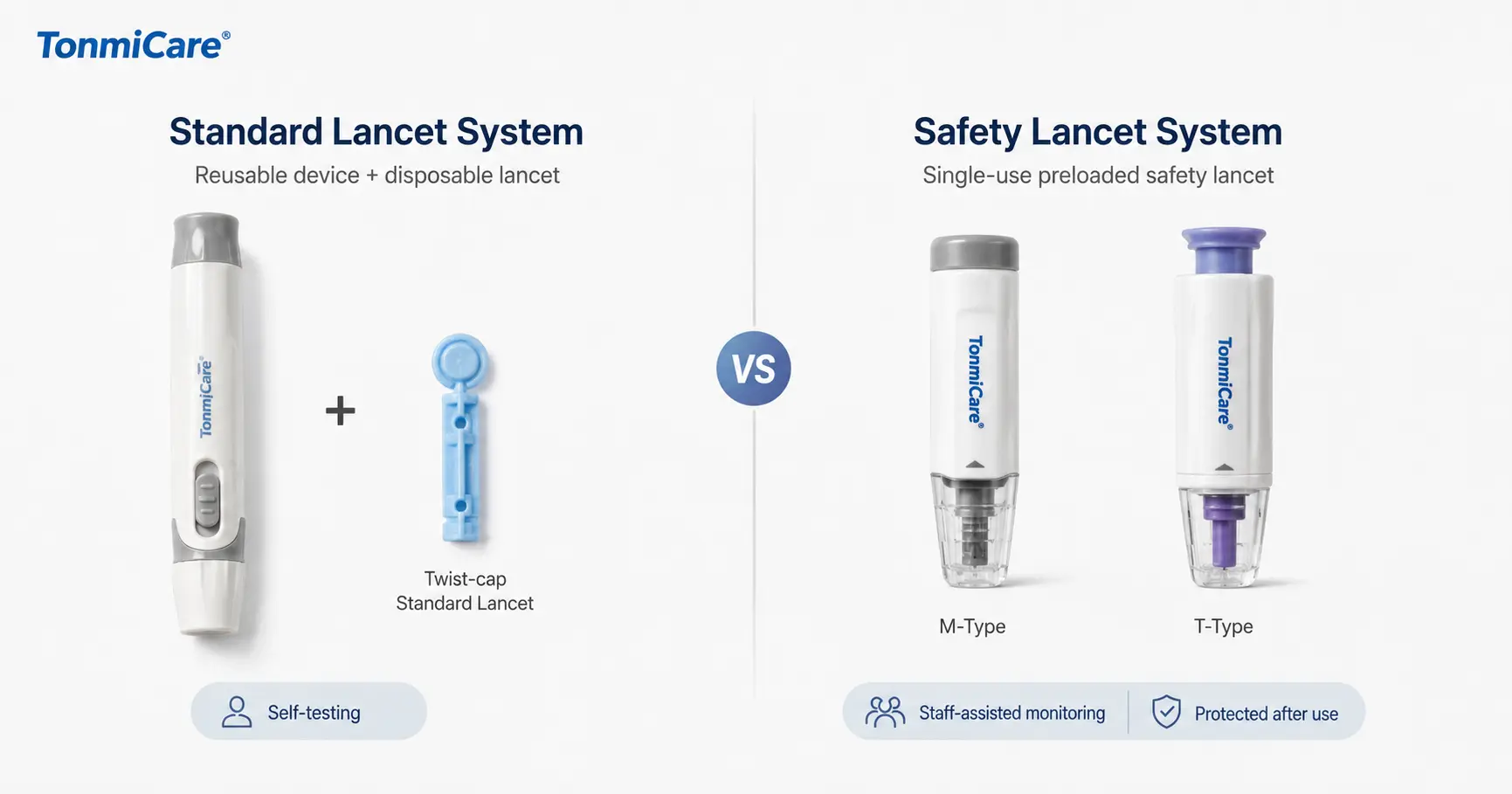
Standard lancets and safety lancets are different procurement systems, not interchangeable versions of one product. A standard twist-cap lancet is normally loaded into a compatible reusable lancing device. The lancet is discarded after one use, while the lancing device may be reused only for the same individual under its current labeling and instructions. A safety lancet is generally a preloaded, disposable fingerstick device that activates once and incorporates a mechanism intended to prevent reuse or shield the sharp after puncture.

The correct choice starts with who performs the test. For personal self-monitoring, a compatible standard lancet and dedicated lancing device can form an appropriate system when used exactly as labeled. For staff-assisted blood glucose monitoring, CDC recommends single-use, auto-disabling fingerstick devices and states that fingerstick devices must never be used for more than one person.[1] A pharmacy should therefore build separate retail and professional-service assortments rather than declaring either category universally “better.”

01Define settingSelf-testing or staff-assisted
02Freeze identityManufacturer, REF and pack
03Match performanceGauge, depth and sample need
04Verify mechanismActivation, lockout and retraction
05Model costCompleted sample, not piece price

1. Standard Lancets vs Safety Lancets Comparison Table

Compare product architecture before comparing price
Buyer question Standard lancet system Safety lancet
Basic architecture Disposable lancet loaded into a compatible reusable lancing device Preloaded, standalone disposable fingerstick device
Reuse boundary Lancet is single-use; reusable base remains dedicated to one individual Entire device is discarded after one activation
Typical channel Personal self-testing and retail replacement demand Assisted monitoring, clinics, health fairs and institutional programs
Compatibility Must be verified with the exact lancing device No separate lancing device, but intended use still remains REF-specific
Depth control Usually created by the lancing device and its settings Fixed or model-specific; some families may offer several versions
Safety behavior Depends on cap handling, loading, ejection and disposal workflow May retract, lock or otherwise auto-disable after activation
Unit economics Often lower lancet piece price, plus device and management costs Often higher device piece price, with fewer separate components
Substitution control Do not substitute without compatibility evidence Do not substitute gauge, depth, activation or flow category by appearance

The descriptions above are category-level controls. They do not establish that every safety lancet retracts in the same way, that every standard lancet is compatible with a given device, or that one gauge and depth combination is suitable for every intended test.

2. A Standard Lancet Is One Part of a Lancing System

A standard lancet usually has a protective twist cap and is loaded into a reusable pen-like device. The device controls loading, release and actual skin penetration. The user removes and discards the lancet after the test, while the reusable base remains assigned to the same individual.

This system architecture creates four separate purchasing decisions:

  • Lancet identity: manufacturer or labeler, REF, gauge, needle dimensions, protective cap and sterility.
  • Device identity: exact reusable lancing-device model, depth settings and loading/ejection design.
  • Compatibility: written evidence that the lancet and device are intended to function together.
  • Single-person control: labeling, assignment and storage that prevent the reusable device from moving between people.

Tonmit’s current standard blood lancet options list selected 28G, 30G, 32G and 33G configurations. The page also instructs buyers to confirm compatibility with the selected lancing device rather than assuming universal fit.

Changing the lancet does not make a shared reusable device acceptable

FDA and CDC identify contamination risks in the reusable base and state that fingerstick devices should never be used for more than one person—even when the lancet is changed.[1][2]

3. “Safety Lancet” Does Not Describe One Universal Mechanism

A safety lancet is generally preloaded and discarded as a complete unit. Depending on the exact model, activation may occur by pressing the device against the puncture site, depressing a button or completing another defined step. After activation, the sharp may retract into the housing, become locked or be otherwise prevented from a second use.

Buyers should not approve a product based only on the word “safety.” The evaluation should document:

  • whether the sharp is shielded before use;
  • how intentional activation occurs and whether premature activation is reasonably controlled;
  • whether the device can activate more than once;
  • whether the used sharp permanently retracts or remains fully contained;
  • whether the user receives visible, tactile or audible completion feedback;
  • whether the mechanism can be bypassed during normal use;
  • how the activated device is placed into the approved sharps container.

FDA’s blood lancet labeling guidance distinguishes multiple-use-capable devices from single-use disposable devices and recommends that disposable devices used for assisted blood draws be clearly labeled for single use, with safe-disposal instructions and a description of any self-disabling feature.[2]

4. Choose the Lancet Category by Use Setting

Setting comes before gauge, price and packaging
Use setting Procurement direction Control that cannot be skipped
Individual self-testing Compatible standard lancet and dedicated lancing device, or an appropriate disposable safety lancet Follow the exact product labeling and never share the device
Pharmacy retail replacement Stock standard lancets only for verified device demand; special-order proprietary or uncommon fits Confirm the consumer’s exact device rather than promising “universal” compatibility
Pharmacist- or staff-assisted test Single-use, auto-disabling fingerstick device consistent with CDC recommendations One device per procedure, immediate point-of-use sharps disposal
Clinic or health fair Safety lancet selected within the facility’s exposure-control and testing workflow Staff training, clean/used separation, gloves, hand hygiene and meter controls
Long-term care Single-use auto-disabling devices for assisted monitoring Prevent any reuse or resident-to-resident movement of fingerstick devices
Professional test needing a defined sample Exact safety-lancet REF aligned with the test system’s sample requirements Gauge or blade width, depth and labeled flow category must be reviewed together
Standard lancet system vs safety lancet system showing reusable lancing device with disposable lancet compared with single-use preloaded safety lancets for self-testing and staff-assisted monitoring

5. Apply CDC Controls to Assisted Blood Glucose Monitoring

CDC separates self-monitoring, where an individual performs every step, from assisted monitoring, where another person performs or helps with testing. For assisted monitoring, CDC recommends single-use, auto-disabling fingerstick devices and specifically recommends selecting single-use lancets that permanently retract after puncture.[1]

Lancet selection is only one part of the workflow. The same CDC guidance also calls for:

  • never using a fingerstick device for more than one person;
  • disposing of used lancets at the point of use in an approved sharps container;
  • assigning a glucose meter to one person whenever possible;
  • using a professional-use meter if sharing is necessary in a healthcare or congregate setting;
  • cleaning and disinfecting a shared professional-use meter after every use according to its manufacturer’s instructions;
  • keeping unused supplies in a clean area separate from used equipment;
  • changing gloves between people and performing hand hygiene after glove removal.

A safety lancet therefore does not make an otherwise uncontrolled testing process compliant. Meter selection, disinfection compatibility, hand hygiene, clean/dirty zoning, staff training and sharps disposal remain separate controls. The diabetic testing supplies buying guide explains how to control meters, strips, lancets and control solutions as one validated system.

6. OSHA Does Not Create One Universal Lancet Rule for Every Pharmacy

OSHA’s Bloodborne Pathogens Standard applies to employers whose workers have reasonably anticipated occupational exposure to blood or other potentially infectious materials. Employers with employees exposed to contaminated sharps must consider and implement appropriate, commercially available and effective safer medical devices designed to eliminate or minimize occupational exposure.[3][4]

That does not justify the blanket statement “OSHA requires safety lancets in every pharmacy.” A pharmacy that only sells unopened boxes and a pharmacy whose employees perform fingersticks have different exposure pathways. The latter should integrate lancet evaluation into its facility-specific exposure-control process.

EVALUATE

Document the device decision

Compare commercially available safety mechanisms, intended workflow, effectiveness, limitations and employee feedback rather than selecting only from a catalog description.

IMPLEMENT

Connect product and work practice

Train affected staff, position sharps containers, define post-exposure steps, review the exposure-control plan and maintain required records under the applicable program.

“Safety” does not mean zero risk

A retraction or lockout feature can help reduce exposure, but safe performance still depends on the exact design, correct activation, training, disposal access and the way employees use the product in the real workflow.

7. Gauge Alone Is Not Enough to Select a Lancet

Gauge describes needle diameter: within the same gauge system, a higher gauge number generally indicates a smaller outside diameter. It does not independently define actual puncture depth, blood volume, pain, device compatibility or suitability for a test.

For a standard lancet, the exposed needle dimension listed in a component specification should not be presented as the actual skin penetration depth. The reusable lancing device, its adjustment mechanism and the way the lancet seats inside it influence the controlled puncture. For a safety lancet, depth is generally fixed or assigned to the exact device configuration.

Buyer control unit Exact lancet = manufacturer + REF + architecture + gauge/blade + depth + activation + pack

Two products labeled 30G are not automatically equivalent if one penetrates 1.5 mm and another 1.8 mm, if one is a loose lancet and another is preloaded, or if the activation and post-use mechanisms differ. Gauge should therefore never become the sole substitution field in the pharmacy item master.

8. Needle and Blade Safety Lancets May Serve Different Sample Needs

Safety lancet portfolios can include needle-based and blade-based configurations. Some manufacturers group variants by low, medium or high flow, while others identify a gauge and depth or a blade width and depth. These are product-family conventions, not universal performance standards.

A study in 100 healthy adults tested 16 versions across four safety-lancet types and found meaningful differences in collected blood volume between needle and blade devices. Pain ratings were generally low, but also varied across tested devices. The study was sponsored by a safety-lancet manufacturer and evaluated specific products, so its measured results should not be assigned to an untested SKU.[8]

Translate a testing requirement into exact product fields
Field What it can tell the buyer What it cannot prove alone
Gauge Nominal diameter category for a needle Actual blood volume, comfort or equivalence
Blade width One dimension of a blade-based incision Complete incision geometry or sample yield
Penetration depth Model-specific depth under labeled operation Performance across all users and sites
Flow category Manufacturer-defined positioning within a product family A standardized microliter output across brands
Test sample requirement Minimum specimen need of the exact test system That every puncture will produce that amount

9. Never Assume Standard Lancets Fit Every Lancing Device

Retail listings often use phrases such as “universal” or “fits most,” but procurement approval needs evidence for the exact pairing. Hub diameter, flange geometry, lancet length, loading and ejection mechanics can affect whether the device functions correctly.

Accu-Chek states that its 28G Softclix lancets can only be used with its Softclix lancing device and warns that other lancets can impair or damage the device.[7] That example does not mean every standard lancet is proprietary. It demonstrates why a buyer should not approve compatibility from gauge, color or visual similarity.

For each standard-lancet item, maintain:

  • supported lancing-device model or documented compatible format;
  • source and revision date of the compatibility evidence;
  • known exclusions or proprietary systems;
  • substitution approval status;
  • complaint path for loading, release or ejection failures.

Tonmit’s reusable lancing-device options are reviewed by device model, depth settings and compatible lancet format. Final compatibility should be confirmed by SKU and RFQ.

10. Compare Activation, Lockout and Retraction as Separate Fields

“Contact activated,” “pressure activated,” “button activated,” “retractable” and “auto-disabling” describe different parts of the device sequence. They should not be used as synonyms.

BEFORE USE

Pre-use shielding

Confirm whether the sharp remains enclosed during unpacking, positioning and removal of any protective cap.

ACTIVATION

Intentional trigger

Document the step that releases the sharp and whether the device offers clear activation feedback.

AFTER USE

Irreversible state

Verify permanent retraction, shielding or lockout and the exact disposal instructions.

BD’s contact-activated lancet provides a useful exact-product example: the manufacturer describes consistent depth, automatic retraction and prevention of reuse, while its product variants use different gauges, blade widths, depths and flow positions.[6] The correct inference is that safety mechanisms and performance fields vary by REF—not that every contact-activated device has the same performance.

11. Match the Lancet to the Test’s Sample Requirement

A blood glucose strip may require a small specimen, while a different point-of-care test or capillary collection method may require more. A procurement team should obtain the current sample requirement from the exact test system and then evaluate candidate lancets within their labeled intended use.

Do not promise a fixed blood volume from gauge and depth alone. Manufacturer information may classify a device by flow or provide product-specific data, but actual collection also depends on the user, puncture site, circulation, technique and collection time. BD explicitly notes that collected volume depends on both the safety lancet and the patient.[6]

Use repeat sticks as an operational metric

During a facility-controlled evaluation, track whether the exact device produces an acceptable sample in the real workflow. Do not turn one small internal trial into a universal clinical claim, but use repeat-stick observations to compare total use cost, training needs and workflow fit.

12. Compare Total Cost per Completed Acceptable Sample

Standard lancets often have a lower unit price because the buyer is purchasing only the disposable component. Safety lancets include the housing, activation mechanism and post-use safety behavior in each unit. That makes a piece-price comparison incomplete.

Cost model Cost per completed sample = product + device allocation + repeat sticks + labor + training + disposal + loss
Cost inputs differ by product architecture
Cost element Standard lancet system Safety lancet
Disposable unit One lancet per test One complete device per test
Reusable equipment Lancing device purchase, assignment, storage and replacement No separate reusable lancing device
Handling Load, set, release, remove/eject and dispose Prepare, activate, confirm post-use state and dispose
Compatibility loss Higher risk if device installed base is not mapped Lower device-fit risk, but exact intended use still controls
Repeat procedure Measure for the exact device, test and trained workflow
Waste Include damaged barriers, expired lots, premature activation, opened units and rejected stock
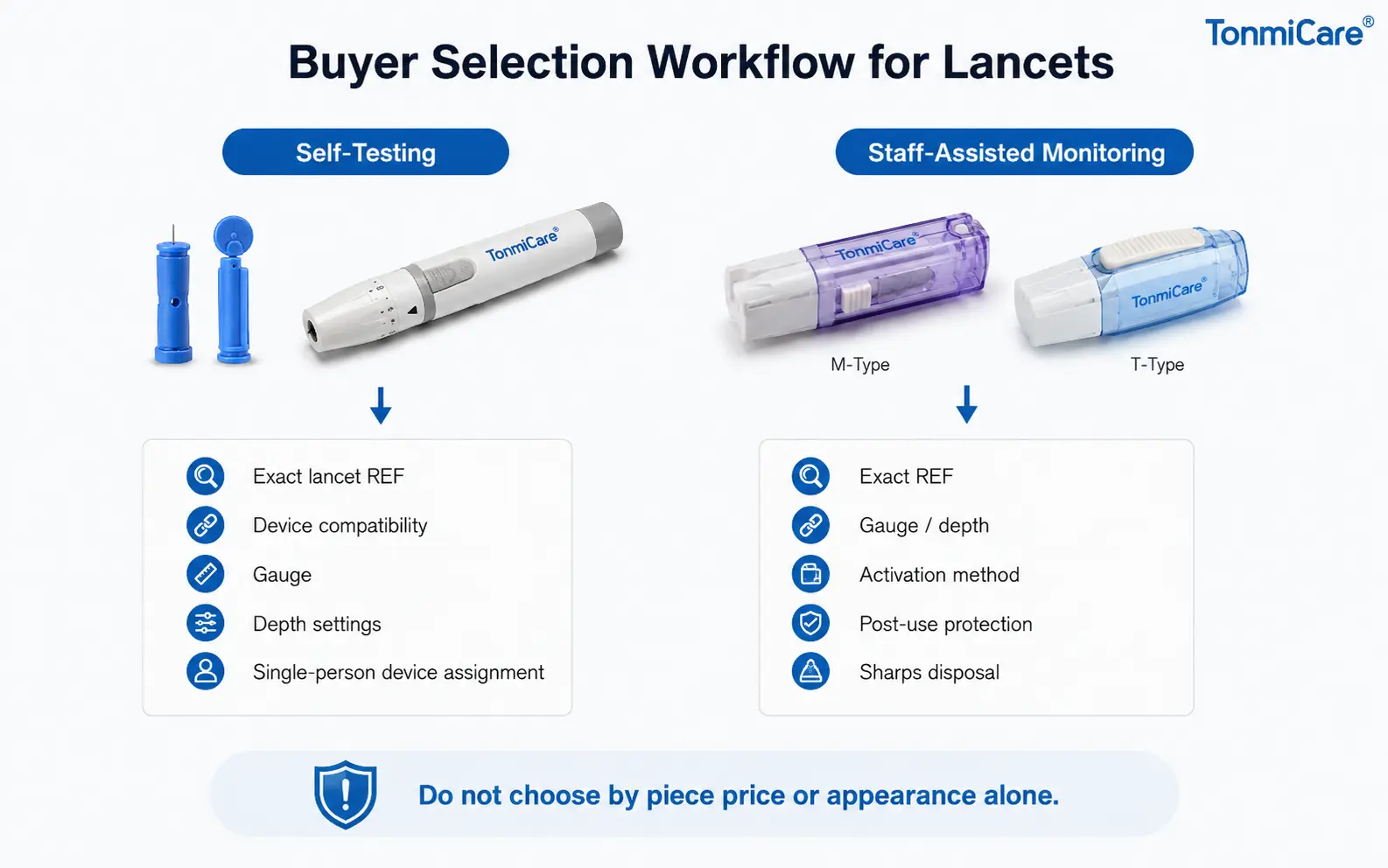
Buyer selection workflow for standard and safety lancets covering exact REF, device compatibility, gauge, depth, activation method, post-use protection and sharps disposal

13. Compare Box Quantity, Case Pack, MOQ and Usable Units

“100 per box” is not a complete wholesale offer. Buyers need the sellable unit, inner pack if any, master case, case dimensions and weight, pallet pattern, minimum order quantity, lead time, lot policy and destination-specific fulfillment terms.

Different product families can use different case packs even when the retail box count is identical. Tonmit’s currently published pages list 100 per box and 10,000 per case for selected standard blood lancets, 100 per box and 2,000 per case for listed M-Type safety lancets, and 100 per box and 1,000 per case for listed T-Type safety lancets. These numbers apply only to the configurations on those pages and must be reconfirmed in the quotation.

SELLABLE

Box-level control

Confirm units per box, barcode, label space, expiry visibility and whether the box matches pharmacy or clinic issue quantities.

LOGISTICS

Case-level control

Confirm boxes and units per case, dimensions, weight, lot mixing and warehouse handling requirements.

DEMAND

Usable-unit control

Convert MOQ into months of supply and compare it with remaining shelf life and realistic inventory turns.

For broader commercial planning, review the wholesale diabetic supplies guide covering MOQ, case packs and shipping.

14. Control Sterility, Package Integrity, Lot and Expiry at Receipt

Neither a protective twist cap nor a safety-lancet housing should be treated as proof that a received unit remains acceptable. Receiving personnel should verify the actual sterile-barrier presentation, damage condition and label against the approved SKU record.

  • Identity: product name, manufacturer or labeler, REF and approved configuration.
  • Specification: standard or safety architecture, gauge or blade, depth and activation mechanism.
  • Sterility: exact label claim and documented sterilization method for the approved product.
  • Package condition: no opened, missing, cracked, wet, crushed or otherwise compromised protective presentation.
  • Traceability: readable lot, expiration date and applicable barcode/UDI information.
  • Quantity: correct units per box, boxes per case and received case count.
  • Remaining life: compliance with the purchase order’s minimum-dating rule.
  • Disposition: quarantine and investigate mismatches rather than releasing by visual similarity.

Accu-Chek’s current product information provides a product-specific example: it instructs users not to use a lancet if its protective cap is damaged or missing and not to use it after the printed use-by date.[7] Buyers should apply the corresponding current instructions for their own approved SKU.

15. What Should Pharmacies Stock and What Should They Special-Order?

Build inventory from documented demand, not a generic “complete” range
Inventory tier Standard lancets Safety lancets
Core stock candidate Selected exact SKUs that match a documented local installed base of lancing devices and repeat retail demand Exact SKUs used by the pharmacy’s own testing service or supported by a stable clinic/institutional account
Conditional stock Less common gauge or compatible format with recurring but moderate demand Additional depth, gauge or flow option supported by forecasted professional use
Special-order Proprietary, legacy or unverified device fit; isolated request with no repeat history Specialized blade/depth configuration, low-turn clinic need or use case requiring separate review
Do not substitute automatically Different device compatibility, hub geometry or approved pairing Different activation, penetration, post-use mechanism or sample category

A pharmacy that only retails personal-use supplies may carry substantially more standard lancets than safety lancets. A clinic, long-term-care supplier or pharmacy operating a professional testing program may have the opposite demand. Local transaction history and contracted services should determine the mix.

16. Compare Tonmit Lancet Options by Exact Published Configuration

The table below illustrates why product-family names are not purchase specifications. It summarizes selected information currently published on Tonmit product pages; final REF availability, documentation, packaging and destination terms must be confirmed in the RFQ.

Published Tonmit examples—verify the quotation before ordering
Product family Published configurations Packaging shown Buyer control
Twist-cap blood lancets 28G, 30G, 32G and 33G; listed 3 mm needle dimension 100/box; 10,000/case Confirm exact lancing-device compatibility and do not treat needle length as controlled skin depth
M-Type safety lancets Listed 21G × 2.4 mm and 23G/28G/30G × 1.8 mm options 100/box; 2,000/case Confirm REF, one-step activation, retraction behavior and irradiation method
T-Type safety lancets Listed 21G, 23G, 28G and 30G options; 1.8 mm and selected 2.4 mm configuration 100/box; 1,000/case Confirm pressure activation, post-use safety behavior, exact gauge/depth pair and gamma irradiation claim

These rows are not clinical recommendations and do not establish interchangeability. A buyer should compare the selected REF with the intended test, use setting, current labeling and facility controls.

17. Documents to Request Before Approving a Lancet SKU

PRODUCT

Exact-SKU evidence

  • Product specification and current IFU
  • Label artwork and package hierarchy
  • Gauge/blade and depth configuration
  • Activation and post-use mechanism
  • Compatibility evidence where applicable
  • Sterility and shelf-life information
TRANSACTION

Shipment and supply evidence

  • Manufacturer/labeler identity
  • REF, lot and expiry on shipment records
  • Box, case, GTIN/UDI fields where applicable
  • Minimum remaining shelf life
  • MOQ, lead time and fulfillment path
  • Change notification and complaint contacts

Do not accept a general certificate packet as proof for every lancet offered by the supplier. Map each document to the legal manufacturer or labeler, product family, exact REF, packaging configuration and destination market. A registration or establishment record is not the same as product approval, performance equivalence or authorization to substitute one SKU for another.

18. Lancet RFQ Template for Pharmacies and Clinics

Product category: Standard twist-cap lancet / single-use safety lancet

Intended setting: Retail self-testing / pharmacy service / clinic / long-term care / distributor program

User model: Individual self-testing / staff-assisted monitoring

Required architecture: Loose lancet for compatible device / preloaded auto-disabling device

Gauge or blade: [insert required specification]

Penetration depth: [insert exact requirement or request available options]

Activation method: [contact / pressure / button / other]

Post-use mechanism: [permanent retraction / lockout / other documented design]

Lancing-device compatibility: [manufacturer and model, if standard lancet]

Test/sample requirement: [exact test system and documented specimen need]

Packaging: Units/box, boxes/case, case dimensions, weight and pallet quantity

Quantity: Initial order and estimated annual demand

Dating: Minimum remaining shelf life required at receipt

Documentation: Specification, IFU, labels, sterility/shelf-life information, applicable market records and change notification

Destination: Country, state, city and ZIP/postal code

Fulfillment: U.S. warehouse availability or factory lead time

19. Standard and Safety Lancet Frequently Asked Questions

Are safety lancets better than standard lancets?

Not universally. Safety lancets are the appropriate purchasing direction for many staff-assisted monitoring workflows because they are single-use, standalone devices with an auto-disabling or retracting design. A compatible standard lancet system can remain appropriate for one individual’s self-testing. The use setting determines the category.

Can a standard lancet be used without a lancing device?

A standard twist-cap lancet is normally designed to be loaded into a compatible lancing device. Do not improvise manual use or treat it as a standalone safety device. Follow the exact labeling and IFU.

Do standard lancets fit every lancing device?

No universal fit should be assumed. Some lancets may support several compatible devices, while proprietary systems may accept only specific lancets. Verify the exact pairing before stocking or substitution.

Can a reusable lancing device be shared if the lancet is changed?

No. CDC and FDA state that fingerstick devices should never be used for more than one person. Blood can contaminate the reusable base even when the disposable lancet is replaced.

Can a shared lancing device be cleaned between patients?

Do not use cleaning as a basis for sharing a reusable fingerstick device. FDA guidance recommends that multiple-use-capable lancet devices be limited to a single patient and not be used for assisted blood draws at healthcare sites.

Are safety lancets reusable?

No. They are intended as single-use disposable devices. An auto-disabling mechanism is designed to prevent a second activation, but the exact behavior should be verified in the applicable labeling.

Does automatic retraction eliminate the need for a sharps container?

No. CDC recommends point-of-use disposal of used lancets in an approved sharps container. Retraction reduces access to the sharp; it does not convert a blood-contaminated device into ordinary waste.

Are safety lancets required by OSHA?

OSHA’s Bloodborne Pathogens Standard applies when employees have occupational exposure. Covered employers must evaluate and implement appropriate, commercially available and effective engineering controls. The exact obligation depends on the employer, exposure pathway, device options and applicable federal or state-plan requirements; it is not a blanket product rule for every pharmacy.

Does a higher gauge number always mean less pain?

No. A higher gauge number generally indicates a smaller needle diameter, but perceived pain also depends on depth, tip design, activation, device movement, puncture site, technique and individual response. Do not convert gauge into a universal comfort claim.

How should a clinic choose the gauge and depth?

Start with the intended test and its sample requirement, then review the exact lancet’s labeled use, gauge or blade, penetration depth, flow positioning and facility evaluation. This article does not select a configuration for an individual patient.

What is the difference between contact-activated and button-activated lancets?

The terms describe how the user triggers the device. Neither term by itself proves permanent retraction, auto-disable, blood volume or suitability. Review the complete activation and post-use sequence for the exact REF.

Can a safety lancet substitute for a standard lancet?

It may satisfy a different workflow, but it is not a direct component substitution. A safety lancet is a standalone device; a standard lancet belongs to a reusable-device system. Update the approved item, training, packaging, cost and disposal review before changing categories.

What should a pharmacy request from a wholesale lancet supplier?

Request the exact manufacturer or labeler, REF, product architecture, gauge or blade, penetration depth, activation and post-use mechanism, intended use, compatibility where applicable, sterility, shelf life, label/IFU, box and case quantities, lot/expiry controls, MOQ, lead time and destination-specific documentation.

20. Use Setting First, Exact SKU Second, Price Third

The most defensible standard lancets vs safety lancets decision begins with the monitoring workflow. Personal self-testing can use a compatible standard lancet and dedicated reusable lancing device. Staff-assisted monitoring should be built around single-use, auto-disabling fingerstick devices in line with CDC recommendations and the facility’s occupational-exposure controls.

After the category is selected, buyers should compare the exact REF—not a generic gauge description. Control the product architecture, gauge or blade, penetration depth, activation, permanent post-use state, sample requirement, compatibility, packaging, lot, expiry, documentation and total cost per completed sample. This prevents a low unit price or familiar product name from overriding infection-control and workflow requirements.

Official and Primary Sources Used for This Guide

  1. CDC — Considerations for Blood Glucose Monitoring and Insulin Administration
  2. FDA — Blood Lancet Labeling Guidance
  3. OSHA — Bloodborne Pathogens and Needlestick Prevention Quick Reference
  4. OSHA — 29 CFR 1910.1030 Bloodborne Pathogens Standard
  5. FDA — Blood Glucose Monitoring Devices
  6. BD — Microtainer Contact-Activated Lancet Product Information
  7. Accu-Chek — Softclix Lancet Compatibility and Handling Information
  8. Serafin et al. — Blood Volume and Pain Perception Across Safety Lancets

Official links, product information and supporting statements were reviewed on August 25, 2026. FDA guidance describes the agency’s current thinking and is nonbinding unless specific statutory or regulatory requirements are cited. OSHA applicability depends on the employer and occupational exposure. Product pages and research findings apply only to the identified devices and study conditions. Requirements, labels and web addresses can change; verify current controlled information before a future purchasing decision.

Exact-SKU Lancet Procurement Support

Match the Lancet to the Testing Workflow

Share the intended setting, user model, required gauge or blade, penetration depth, activation and post-use mechanism, compatible lancing device if applicable, box/case target, annual demand, destination and documentation requirements. Tonmit can review published standard and safety lancet options, packaging, fulfillment paths and project-specific supply requirements.

Leave a Reply