Safety Lancet Specification & Procurement Guide
An evidence-bounded guide for U.S. pharmacies, clinics, long-term-care suppliers and medical distributors comparing safety lancet gauge, published penetration depth, fixed and adjustable designs, pressure and button activation, post-use protection, exact-SKU documentation, packaging and total procurement cost.
Scope: This guide supports professional purchasing, assortment planning, item-master control and supplier review for finished single-use safety lancets. It does not choose a lancet for an individual, prescribe a puncture site or depth, provide a capillary-sampling procedure, authorize heel or alternate-site use, replace current labeling or an IFU, or provide legal, clinical, infection-control or occupational-safety advice. Confirm the exact manufacturer or labeler, REF, intended use, intended population and site, published specification, destination market, packaging and current controlled documentation before purchase or substitution.
Direct answer
How Should Healthcare Buyers Compare Safety Lancet Depth and Activation?
Compare the complete exact-SKU design—not depth or activation alone. A defensible safety-lancet purchase identifies the intended setting and test, the manufacturer or labeler and REF, needle gauge or blade dimensions, the published penetration-depth specification, fixed or selectable settings, the activation method, the permanent post-use state, sterility and dating, and the complete box and case configuration.
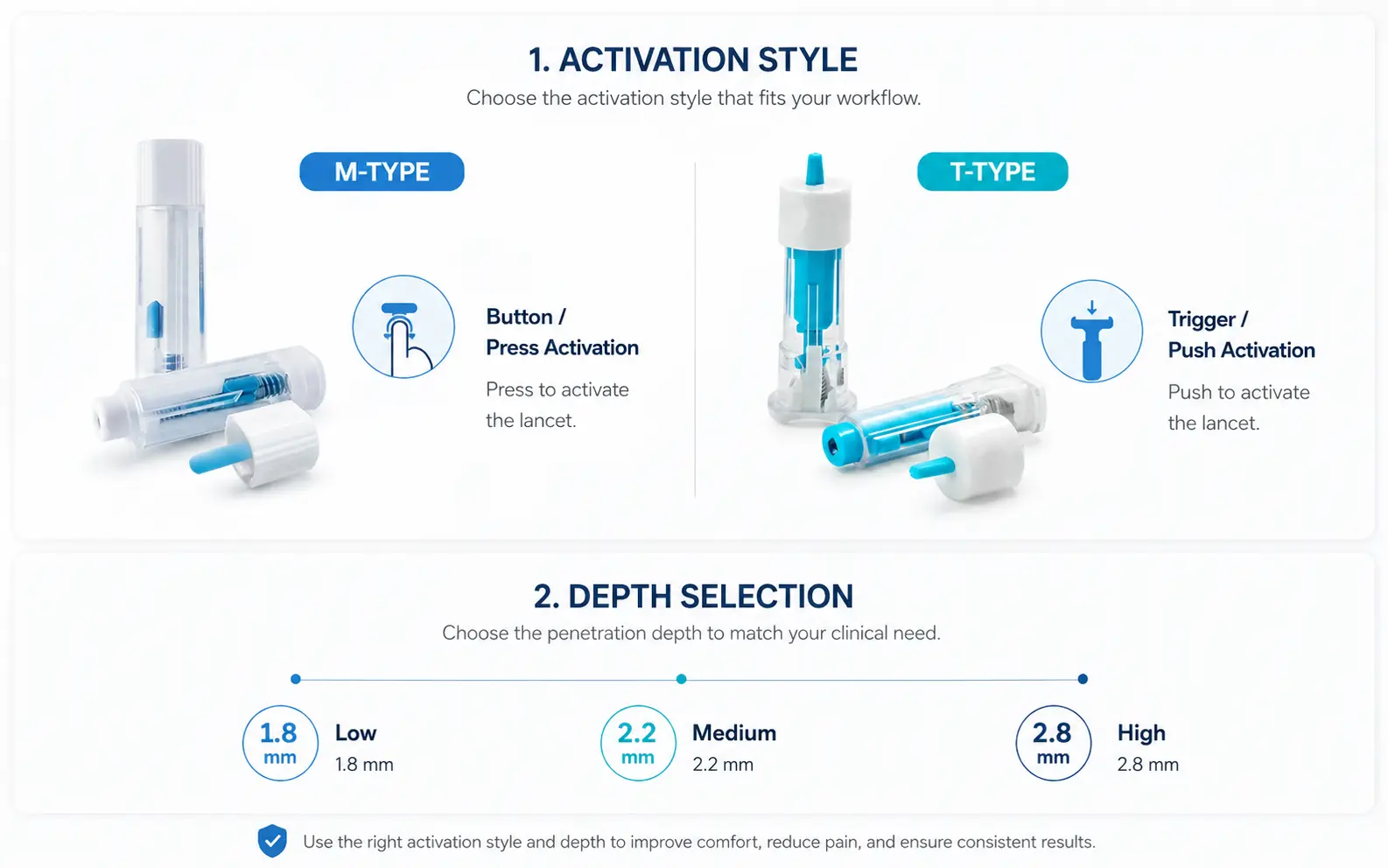
There is no universal “best” safety lancet depth or activation type for every pharmacy, clinic, patient population or point-of-care test. Contact- or pressure-activated models may support a one-step placement-and-press workflow. Button-activated models separate positioning from firing and may be fixed or adjustable. Neither activation category by itself proves sample volume, comfort, automatic retraction, reuse prevention or suitability for an intended procedure.
Buyer definition
1. A Safety Lancet Is a Complete Single-Use Fingerstick Device
A safety lancet is generally supplied as a preloaded, standalone device. The sharp is protected before use, the product is activated once through its intended mechanism, and the used sharp is then retracted, locked or otherwise permanently contained according to the exact design. The complete device is discarded after one procedure.
This architecture differs from a standard loose lancet that is inserted into a reusable personal lancing device. The standard lancets vs safety lancets guide explains that broader category decision. The present guide starts after the buyer has determined that a standalone safety lancet is the appropriate product architecture.
A standalone safety lancet contains its own loading, release and post-use protection mechanism. Do not describe it as a refill for a pen-style device or add it to a reusable-device compatibility chart. For loose-lancet systems, use the separate lancing device compatibility guide.
Quick comparison
2. Safety Lancet Depth and Activation Comparison Table
| Design | How it is triggered | Depth control | Procurement benefit | Buyer check |
|---|---|---|---|---|
| Contact/pressure, fixed depth | Press the prepared device against the intended site until it fires | Assigned to the exact model or REF | Few operating steps and no depth-setting decision | Activation force, depth, post-use state and premature-fire controls |
| Contact/pressure, adjustable depth | Set the labeled depth, then press against the site | Several selectable positions within one model | May consolidate several depth needs into one SKU | Setting visibility, setting retention and staff training |
| Button, fixed depth | Position the device, then depress the top or side trigger | Assigned to the exact model or REF | Separates positioning from intentional firing | Trigger access, grip, orientation and completion feedback |
| Button, adjustable depth | Select the setting, position the device and press the trigger | Several selectable positions within one model | Broader configuration coverage from one commercial unit | Correct setting, training, documentation and complaint traceability |
These four descriptions are purchasing categories, not universal technical standards. Manufacturers may use “contact activated,” “pressure activated,” “top activated,” “push button” or other wording differently. Preserve the terminology and operating sequence in the current IFU for the exact product.
Specification control
3. Gauge, Depth, Activation and Retraction Are Four Separate Fields
A catalog line that lists only “28G safety lancet” is incomplete. At minimum, the item master and purchase order should separate the following fields.
Needle gauge or blade dimensions
Identifies the nominal diameter category of a needle, or the width and other controlled dimensions of a blade-based design. It does not define the complete incision by itself.
Published penetration depth
Records the depth assigned to the exact model under labeled operation. It must not be inferred from an unrelated needle-length statement.
Activation method
Explains how the user intentionally fires the product: contact/pressure, top button, side button or another labeled sequence.
Permanent post-use state
Explains whether and how the sharp retracts, locks or remains fully contained and how reuse is prevented after activation.
Depth architecture
4. Fixed-Depth vs Adjustable-Depth Safety Lancets
A fixed-depth lancet assigns one published depth to one exact model or REF. An adjustable-depth lancet offers two or more selectable settings within one device. The choice changes SKU count, training, setting control and complaint investigation.
| Buyer issue | Fixed depth | Adjustable depth |
|---|---|---|
| Commercial identity | One depth assigned to the exact SKU | Several labeled settings within one SKU |
| Inventory range | Different needs may require several REFs | May reduce the number of depth-specific REFs |
| Point-of-use choice | No depth-setting decision on the device | User must select and confirm the intended setting |
| Training control | Focus on product selection and activation | Add setting selection, visibility and retention |
| Complaint investigation | Confirm the exact fixed-depth REF | Confirm REF plus the selected setting and whether it remained in position |
| Substitution | Do not replace with a different depth automatically | Do not assume a selectable setting makes the device equivalent to every fixed-depth product |
An adjustable design may consolidate stock, but it also transfers part of the specification decision to the point of use. A facility should approve the device only after confirming that its workflow can control the setting consistently.
Activation type
5. Contact- or Pressure-Activated Safety Lancets
A contact- or pressure-activated device is generally prepared according to its instructions, placed against the intended puncture site and pressed until the internal mechanism fires. BD describes its Microtainer contact-activated lancet as activating only when positioned and pressed against the skin, supporting a consistent puncture depth for that product family.[5]
The commercial advantage can be a short operating sequence with no separate firing button. That does not remove the need to evaluate activation force, grip, site visibility, protection against unintended activation and the permanent post-use state.
Some manufacturers use the two descriptions interchangeably, while others may define a product family more narrowly. Use the term printed in the current labeling and document the actual activation sequence rather than normalizing every design to one catalog label.
Activation type
6. Top- and Side-Button Safety Lancets
A button-activated design generally allows the user to position the contact surface and then intentionally press a top or side trigger. This separates contact from firing, but exact ergonomics and trigger protection remain product-specific.
Owen Mumford’s current U.S. Unistik Pro Plus page provides a manufacturer-specific example: it describes an adjustable, top-activated safety lancet with 1.3 mm, 1.8 mm and 2.3 mm settings and permanent retraction.[6] Those specifications apply to that identified product and should not be transferred to another button-activated device.
Site visibility and stability
Confirm the housing lets the trained user position the device according to its instructions without obscuring the intended site unnecessarily.
Intentional firing
Review trigger location, force, guard features and whether the device can fire before the user completes the labeled preparation steps.
Completion state
Document the visual, audible or tactile indication—if provided—that distinguishes unused, activated and fully protected states.
Safety mechanism
7. Activation Method Is Not the Post-Use Safety Mechanism
Activation describes how the sharp is released. Retraction, shielding, lockout and auto-disable describe what happens after firing. A contact-activated device may permanently retract, and a button-activated device may also permanently retract. Neither activation label alone proves the complete safety sequence.
| Lifecycle stage | Evidence to review | Procurement question |
|---|---|---|
| Before use | Protective cap, barrier, sterility statement and damage restrictions | Is the sharp inaccessible while the unopened device is prepared normally? |
| Intentional activation | IFU steps, contact force or trigger sequence | What exact action causes the device to fire? |
| Immediately after use | Retraction, lockout or permanent containment description | Can the used sharp become accessible during normal handling? |
| Reuse prevention | Auto-disable behavior and single-use labeling | Can the mechanism complete a second puncture? |
| Disposal | IFU and facility sharps-disposal procedure | Can the activated unit enter the approved container immediately at point of use? |
Automatic retraction does not convert a blood-contaminated product into ordinary waste. CDC recommends disposing of used lancets at the point of use in an approved sharps container.[1] Tonmit buyers can review current 1L sharps container options as a separate procurement category.
Specification boundary
8. Lancet Gauge Describes Diameter—not the Complete Sampling Result
Gauge identifies a nominal needle-diameter category. Within the same gauge system, a higher gauge number generally indicates a smaller outside diameter. Gauge does not independently establish puncture depth, blood volume, pain, intended population, intended site, activation behavior or equivalence between manufacturers.
Two products labeled 30G can use different depths, tip geometry, spring behavior, housing, protective sequence and box configuration. Conversely, a manufacturer may offer several gauges within the same housing family. Capture gauge as one field in the exact product identity, not as the complete item description.
Terminology control
9. Penetration Depth Is Not Automatically the Same as Needle Length
A product page, quotation or specification may use “needle length,” “penetration depth,” “puncture depth” or a size expression that combines gauge and a millimeter value. These terms should not be treated as synonyms without controlled documentation.
| Published field | Safe buyer interpretation | Required follow-up |
|---|---|---|
| Penetration depth | Model-specific controlled puncture depth under labeled operation | Confirm tolerance, setting and applicable REF |
| Needle length | A physical needle dimension as defined by that source | Do not rename it as skin penetration without documentation |
| Gauge × mm | A compact size expression whose second value may be ambiguous | Ask whether mm means needle length, penetration depth or another controlled dimension |
| Low/medium/high setting | A product-family setting name | Record the corresponding labeled depths only when the manufacturer publishes them |
If a public product page lists “1.8/2.4 mm needle length,” quote it as a published length and request the current specification or IFU before calling those values penetration depths. This protects product data, private-label artwork and purchase orders from unsupported reinterpretation.
Published examples
10. How Buyers Should Read Common Safety Lancet Depth Values
Manufacturer portfolios commonly publish values such as 1.3 mm, 1.5 mm, 1.8 mm, 2.2 mm, 2.3 mm or 2.4 mm for identified products or settings. Their presence in the market does not create a universal clinical ladder.
| Example value | Where it may appear | What the buyer must not infer |
|---|---|---|
| 1.3 mm | A shallow setting in selected adjustable product families | That every 1.3 mm device has the same gauge, blood yield or labeled population |
| 1.5 mm | A fixed value in selected fine-gauge product lines | That it is automatically appropriate for every low-sample test |
| 1.8 mm | A fixed value or middle setting across multiple product families | That products sharing the number are interchangeable |
| 2.2–2.4 mm | Selected deeper fixed models or higher settings | That deeper always means an adequate or superior specimen |
The article should not prescribe a depth by age, skin thickness or medical condition. Those decisions belong to the exact intended use, test instructions, current product labeling, facility policy and qualified clinical judgment.
Sampling element
11. Needle and Blade Safety Lancets Are Different Architectures
Some safety lancets use a round needle; others use a blade that creates an incision with a defined width and depth. A blade width should not be converted into a needle gauge, and a needle gauge should not be treated as a complete blade specification.
Record gauge and depth separately
Capture nominal gauge, published penetration depth, tip description when documented, activation method and the exact REF.
Record complete incision dimensions
Capture published blade width, depth, intended site and population, sample positioning and the exact REF. Do not substitute a fingerstick needle device for a heel-incision product.
A manufacturer may group variants as low, medium or high flow, but these are product-family classifications rather than standardized microliter outputs across brands. Any blood-volume statement should be tied to the exact tested product and conditions.
System requirement
12. Start With the Exact Test and Specimen Requirement
A safety lancet produces the specimen; the meter, strip, rapid test, microcollection device or laboratory method defines what specimen is accepted and how much is required. Procurement should begin with the exact test system and its current instructions, then evaluate a labeled safety-lancet configuration that can support the approved workflow.
| Test-system field | Safety-lancet field | Buyer evidence |
|---|---|---|
| Intended specimen | Labeled puncture site and intended use | Test instructions plus lancet IFU |
| Minimum sample requirement | Documented product-family flow or performance information | Manufacturer data for the exact REF; not gauge alone |
| Intended user and setting | Single-use, auto-disabling workflow and training | Current labeling and facility procedure |
| Collection container | Needle or blade architecture and specimen transfer process | Complete approved collection workflow |
For broader system control, review the diabetic testing supplies buying guide for pharmacies. It connects meters, strips, control solutions and sampling devices rather than purchasing each item as an unrelated commodity.
Research interpretation
13. What Published Studies Can—and Cannot—Tell Buyers
Clinical studies can show that device architecture matters, but their measured results remain bounded by the products, participants, sites and procedures tested.
A 2020 study of 100 healthy adults compared 16 versions across four named safety-lancet families. It reported significant differences in mean blood volume between blade- and needle-equipped product groups and generally low pain ratings. The authors were affiliated with a safety-lancet manufacturer, and the results apply to the tested products and study conditions—not to every device with a similar gauge or depth.[7]
An earlier study of 52 healthy participants used one Softclix device with lancets of three diameters and two penetration depths. Within that controlled system, blood volume increased with diameter and depth, while pain relationships varied by depth. It does not establish a cross-brand formula for predicting blood volume or comfort.[8]
Blood obtained can be affected by the exact device, needle or blade geometry, puncture site, individual factors and the collection procedure. Avoid unsupported statements such as “30G always yields X µL,” “1.8 mm fits all adults” or “button activation is painless.”
Infection prevention
14. Apply CDC Controls to Staff-Assisted Monitoring
CDC distinguishes personal self-monitoring from assisted monitoring in healthcare and congregate settings. It states that fingerstick devices should never be used for more than one person and recommends single-use, auto-disabling fingerstick devices for assisted blood glucose monitoring. CDC also recommends selecting single-use lancets that permanently retract upon puncture.[1]
| Workflow | Fingerstick-device direction | Buyer control |
|---|---|---|
| Individual self-testing | Personal device and compatible single-use lancet, or an appropriate standalone product | Follow exact labeling; never share the personal device |
| Staff-assisted monitoring | Single-use, auto-disabling fingerstick device | One device per procedure, permanent post-use protection and immediate disposal |
A safety lancet does not control the complete testing process by itself. Hand hygiene, gloves, clean/used separation, meter assignment or labeled cleaning and disinfection, staff training and point-of-use sharps disposal remain separate controls. FDA’s blood lancet labeling guidance also recommends clear single-patient or single-use limitations and descriptions of self-disabling features.[2]
Occupational exposure
15. OSHA Does Not Create One Identical Rule for Every Pharmacy
OSHA’s Bloodborne Pathogens Standard applies to employers whose employees have occupational exposure to blood or other potentially infectious materials. Covered employers must use appropriate engineering and work-practice controls and consider safer medical devices within the applicable exposure-control process.[3]
OSHA has explained that self-administered personal testing by an employee or resident is not treated the same as an employee performing blood sampling as part of the job; improperly discarded sharps can still create exposure hazards for other workers.[4] Therefore, the article should not say “OSHA requires safety lancets in every pharmacy.” A pharmacy that only sells sealed boxes and a clinic where employees perform fingersticks have different exposure pathways.
Connect the device to the exposure-control process
Review the intended procedure, employee exposure, commercially available safety features, workflow limitations and employee input as applicable.
Connect product selection to work practice
Training, disposal placement, clean/used zoning, post-exposure procedures and required records cannot be replaced by a “safety” label.
Procurement workflow
16. Build an Exact-SKU Safety Lancet Selection Matrix
A controlled matrix lets procurement, clinical operations, receiving, distribution and customer service use the same product identity. A blank field should mean “not yet verified,” not implied approval.
| Matrix field | Record | Do not replace with |
|---|---|---|
| Commercial identity | Manufacturer/labeler, family, exact REF and market | “Safety lancet” or brand name alone |
| Needle or blade | Gauge or complete published blade dimensions | Color or flow nickname |
| Depth | Published penetration depth, fixed or settings | Unverified needle length |
| Activation | Contact/pressure, top button, side button or exact labeled method | “Automatic” without sequence |
| Post-use state | Permanent retraction, lockout or other documented containment | “Safe” without mechanism evidence |
| Intended workflow | Test, specimen, site, population and professional setting as labeled | An application inferred from gauge |
| Pack hierarchy | Units/box, boxes/case, barcode, dimensions and pallet quantity | Unit price without commercial denominator |
| Evidence | IFU/specification title, revision/date and approval status | Undated marketplace copy |
Published product examples
17. Compare Tonmit Safety Lancet Options Without Rewriting the Specification
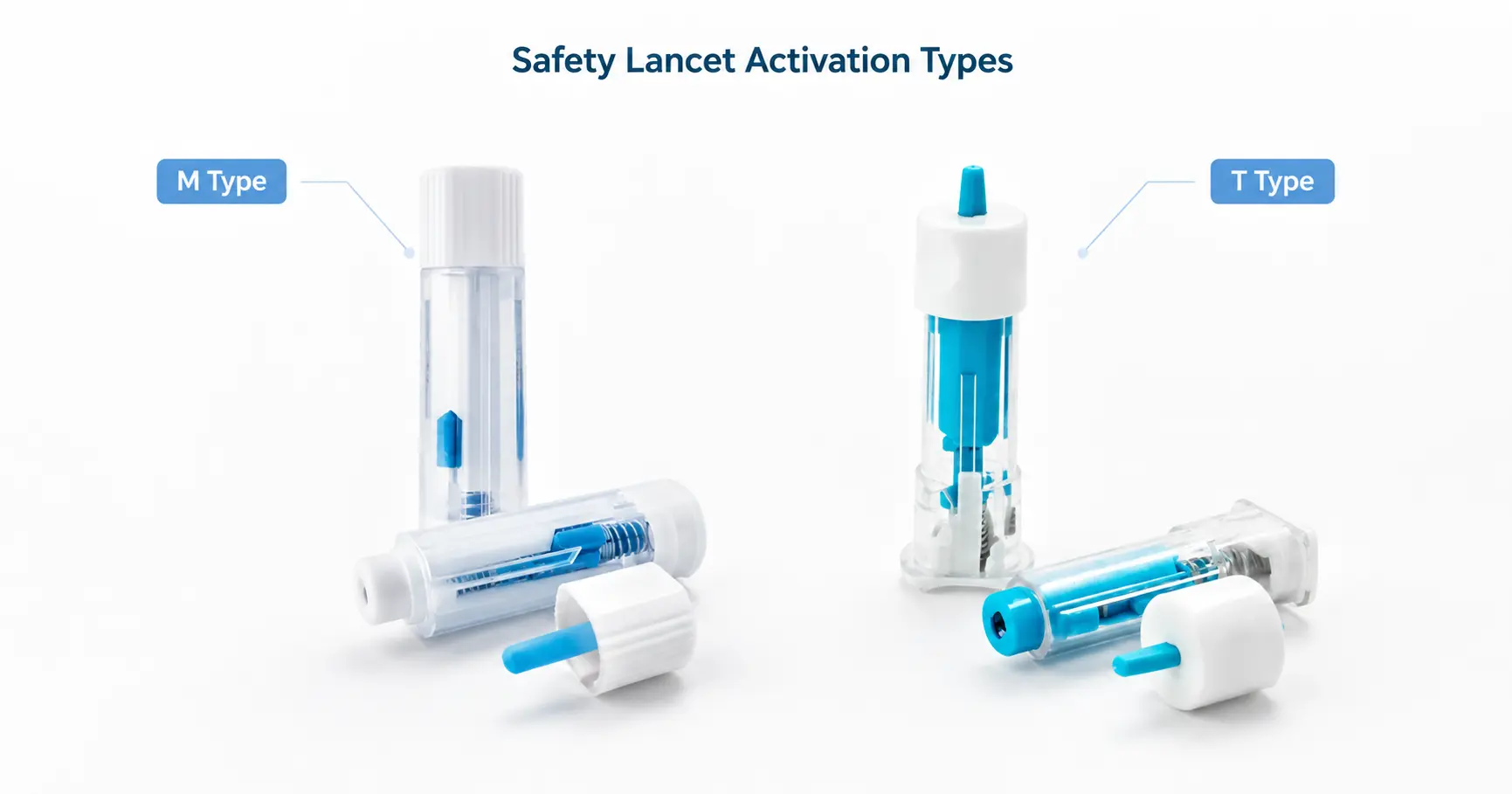
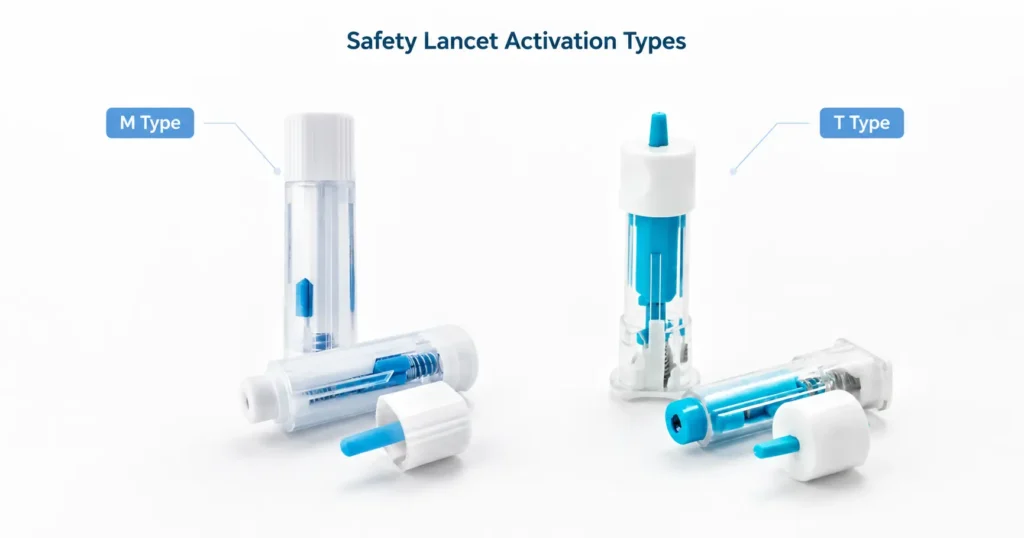
Tonmit’s current public pages show separate M-Type and T-Type safety-lancet families. The table below preserves the terminology currently published on those pages. Final availability, REF, documentation, depth terminology, sterilization, packaging and destination terms must still be confirmed in the quotation and controlled product files.
| Product family | Published specifications | Published packaging | Buyer control |
|---|---|---|---|
| M-Type safety lancets | Public page describes selected 21G–30G options and 1.8/2.4 mm lengths | 100 units/box and 2,000 units/case shown | Confirm exact REF, whether the millimeter value is controlled as penetration depth or needle length, activation sequence and post-use mechanism |
| T-Type safety lancets | Public page lists selected 21G, 23G, 28G and 30G options, 1.8/2.4 mm lengths and pressure activation | 100 units/box and 1,000 units/case shown | Confirm exact gauge–length pair, depth terminology, activation force, post-use shielding and sterility documentation |
The examples demonstrate why M-Type, T-Type, gauge and a millimeter value are not complete purchase specifications. A quotation should identify the exact product code and attach the corresponding documents. Do not merge the two case packs or assume that every option is held in U.S. inventory.
Commercial control
18. Verify Packaging, Lot, Expiry and Barcode Fields
“100 per box” is not a complete wholesale offer. The buyer needs the sellable unit, any inner pack, master case, case dimensions and weight, pallet quantity, lot policy, dating requirement, barcode hierarchy, MOQ, lead time and destination-specific fulfillment terms.
Unit and box
Confirm units per box, exact REF, label language, barcode, lot and expiration visibility, barrier condition and whether the package can be issued as intended.
Case and pallet
Confirm boxes and units per case, dimensions, weight, lot mixing, pallet pattern, warehouse handling and freight denominator.
Usable inventory
Set a written minimum remaining shelf life at shipment or receipt using realistic demand and complete lead time. Do not assume one category-wide shelf life.
UDI applicability and packaging level must be reviewed for the exact product and market. Do not invent a UDI, use a company registration number as a product identifier or claim that a company-level record proves the status of every SKU. For broader MOQ and logistics modeling, use the wholesale diabetic supplies buying guide.
Quality handoff
19. Receiving Inspection and Complaint Coding
Receiving should verify that the shipment matches the approved exact-SKU record before stock is released. Appearance, color or gauge alone is not sufficient.
| Control | Receiving check | Complaint data to preserve |
|---|---|---|
| Identity | Manufacturer/labeler, family, REF, gauge/blade and published depth field | Photographs of device and package; quoted and received SKU |
| Packaging | Box/case count, seals, protective caps and visible damage | Case, box and affected-unit condition |
| Traceability | Lot, expiration, barcode/UDI where applicable and shipment linkage | Lot, expiry, invoice, customer/location and dates |
| Mechanism complaint | Quarantine visibly damaged or mismatched products | No fire, premature fire, incomplete retraction, exposed sharp, damaged cap or unclear used state |
| Performance complaint | Do not test questionable product outside the approved procedure | Exact test, device setting if adjustable, user description and whether a repeat procedure occurred |
Do not discard the traceability record when replacing a box. Preserve the relationship between supplier, shipment, exact lot and affected customer or location according to the organization’s complaint and recall procedures.
Commercial comparison
20. Compare Cost per Completed Acceptable Sample
A lower piece price may be offset by premature activation, repeat procedures, unsuitable case quantities, expired stock, training burden, complaint handling or an unsupported substitution. Compare the total cost of the approved workflow rather than the lancet price alone.
| Cost input | Example | Buyer metric |
|---|---|---|
| Usable-unit loss | Damaged cap, broken barrier or premature activation | Rejected units by lot and reason |
| Repeat procedure | The approved workflow does not produce an acceptable specimen | Repeat rate under the exact test and trained process |
| Training | Adjustable setting or unfamiliar trigger sequence | Training time, observed errors and refreshers |
| Inventory waste | Excess case pack expires before use | Months of supply and expired units |
| Complaint handling | Unclear product identity prevents rapid investigation | Resolution time and replacement cost |
| Disposal | Complete activated housing consumes sharps-container capacity | Containers and collection frequency per procedure volume |
Supplier qualification
21. Documents to Request and a Copyable Safety Lancet RFQ
Exact-SKU evidence
- Manufacturer/labeler and exact REF
- Current specification and IFU
- Needle gauge or blade dimensions
- Published penetration-depth field or selectable settings
- Activation and permanent post-use mechanism
- Intended use, population and puncture site as labeled
- Sterility method and shelf-life information
- Applicable product-specific market records
Supply and traceability evidence
- Unit, box, case and pallet hierarchy
- Label artwork, lot, expiry and barcode fields
- Minimum remaining shelf-life commitment
- MOQ, price denominator and validity
- Lead time and destination-specific fulfillment
- Substitution and change-notification rules
- Complaint, return and recall contacts
- Private-label claim and artwork responsibilities
Copyable Safety Lancet RFQ
Organization and destination: Organization type, country, state, city and ZIP/postal code
Intended setting: Pharmacy service / clinic / long-term care / distributor program / other
User model: Individual self-testing / staff-assisted monitoring
Test or procedure: Exact test system, intended specimen and documented sample requirement
Product architecture: Needle safety lancet / blade safety lancet
Gauge or blade: Exact required gauge or complete blade dimensions
Penetration depth: Fixed depth or labeled selectable settings; clarify whether any quoted mm value is depth or needle length
Activation: Contact/pressure / top button / side button / other labeled method
Post-use mechanism: Permanent retraction / lockout / other documented auto-disable behavior
Packaging: Units/box, boxes/case, case dimensions, weight, pallet quantity and barcode hierarchy
Quantity: Initial order and estimated monthly or annual demand
Dating: Minimum remaining shelf life required at shipment or receipt
Documentation: Specification, IFU, label, sterility/shelf-life information and applicable product records
Private label: Artwork, languages, claims, MOQ, ownership and change-control requirements
Fulfillment: U.S. warehouse availability or factory lead time; destination-specific terms
Substitution: No change to REF, gauge/blade, depth, activation, protection or pack without written approval
Buyer FAQ
22. Safety Lancet Depth and Activation Frequently Asked Questions
What is the difference between safety lancet gauge and penetration depth?
Gauge describes the nominal diameter category of a needle. Penetration depth describes how far the exact device is designed to puncture under labeled operation. They are separate fields and neither one alone defines the complete sampling result.
What do 1.5 mm, 1.8 mm, 2.2 mm and 2.4 mm mean?
They may be published penetration depths, needle lengths or selectable settings depending on the source. Verify the terminology, exact REF and IFU before entering the value into a purchasing system.
Does a deeper safety lancet always produce more blood?
No universal result should be assumed. Blood obtained depends on the exact device, needle or blade geometry, site, user factors and collection procedure. Use the exact test requirement and product evidence.
Is a higher-gauge safety lancet always less painful?
A higher gauge generally means a smaller needle diameter, but pain and sample performance are product- and condition-specific. Do not market a gauge as “painless” without appropriate evidence for the exact product and claim.
What is the difference between pressure-activated and button-activated lancets?
A pressure- or contact-activated model generally fires when the prepared device is pressed against the intended site. A button-activated model generally fires after positioning when the user presses a top or side trigger. Follow the exact IFU because terminology and sequence vary.
Is contact activation the same as pressure activation?
The terms are often used for similar press-against-site designs, but they are not a guaranteed cross-manufacturer standard. Preserve the wording and sequence used for the exact product.
Are button-activated safety lancets safer?
Activation method alone does not establish overall safety. Review pre-use shielding, unintended-activation controls, post-use retraction or lockout, reuse prevention, training and disposal for the exact REF.
What is the difference between fixed and adjustable depth?
A fixed-depth product assigns one published depth to the exact model. An adjustable product provides several labeled settings in one device. Adjustable designs may consolidate SKUs but require setting and training controls.
Can one adjustable lancet replace every fixed-depth lancet?
No. Matching one numeric setting does not prove equivalence in gauge, needle or blade geometry, intended use, activation, post-use behavior, performance, packaging or applicable product records.
Are safety-lancet colors standardized?
No universal color mapping should be assumed. Colors can vary by manufacturer, product family, gauge, depth or commercial market. Use the REF and printed specification.
Are two 28G × 1.8 mm safety lancets interchangeable?
Not automatically. They may differ in actual published terminology, tip geometry, activation, post-use protection, intended use, sterility, package configuration and documented performance.
Do safety lancets need a separate lancing device?
Standalone safety lancets are generally preloaded complete devices and do not use a reusable lancing device. Confirm the exact labeling because retail terminology can be inconsistent.
Can a safety lancet be reused or used for more than one person?
No. It is a single-use device for one procedure. CDC recommends single-use, auto-disabling fingerstick devices for staff-assisted blood glucose monitoring and states that fingerstick devices must never be used for more than one person.
Does automatic retraction eliminate the need for a sharps container?
No. Retraction reduces access to the sharp; it does not make the blood-contaminated device ordinary waste. Follow the IFU and applicable point-of-use sharps-disposal procedure.
Can a fingerstick safety lancet be substituted for a heel-incision device?
Do not make that substitution. The intended site, population, needle or blade dimensions and labeled use must match the procedure. Use a device specifically labeled for the intended heel or fingerstick workflow.
What documents should a buyer request?
Request the exact specification and IFU, label artwork, manufacturer/labeler and REF, needle or blade data, published depth, activation and post-use mechanism, intended use, sterility and shelf-life information, applicable product-specific market records, packaging, traceability and complaint contacts.
What belongs in a wholesale safety-lancet quotation?
Include the exact REF, gauge or blade, depth terminology, activation, post-use mechanism, units/box, boxes/case, MOQ, price denominator, lot/expiry terms, documentation, lead time, destination, freight basis and written substitution restrictions.
Procurement conclusion
23. Select the Exact Safety Lancet—Not a Generic Depth
A reliable safety-lancet decision starts with the intended setting and exact test, then controls needle or blade architecture, gauge, documented penetration depth, fixed or adjustable settings, activation, permanent post-use protection and the complete commercial pack.
Depth, gauge and activation are useful search terms, but they are not interchangeable approval criteria. Preserve source terminology, verify the current IFU and exact REF, connect the product to assisted-monitoring and occupational-exposure controls where applicable, and lock substitutions before ordering. This approach gives pharmacies, clinics and distributors a purchasing record that can support receiving, training, complaints, replenishment and supplier comparison.
Source basis
Official and Primary Sources Used for This Guide
- CDC — Considerations for Blood Glucose Monitoring and Insulin Administration
- FDA — Blood Lancet Labeling Guidance
- OSHA — 29 CFR 1910.1030 Bloodborne Pathogens Standard
- OSHA — Position on Lancets and Lancing Devices Without Safety-Engineered Features
- BD — Microtainer Contact-Activated Lancet
- Owen Mumford — Unistik Pro Plus Adjustable Top-Activated Safety Lancet
- PubMed — Blood Volume and Pain Perception During Finger-Prick Capillary Blood Sampling
- PubMed — Relation Between Lancet Diameter, Lancing Pain and Blood Volume
Official sources, product pages and study records were reviewed on August 25, 2026. CDC and OSHA recommendations must be applied within the actual healthcare and workplace setting. FDA guidance describes the agency’s current thinking and is nonbinding unless specific statutory or regulatory requirements are cited. Manufacturer specifications apply only to the identified product and market. Published studies evaluated specific devices and conditions; their measured results must not be assigned to an untested SKU. Product labels, instructions, regulatory records, availability and web addresses can change; verify current controlled information before a future purchasing decision.
Exact-SKU Safety Lancet Procurement Support
Match the Product to the Testing Workflow
Share the intended setting, test system, required needle or blade configuration, published depth, preferred activation, post-use protection, box/case target, annual demand, destination and documentation requirements. Tonmit can review current M-Type and T-Type product options, packaging, available documentation and project-specific supply terms.