Insulin Syringe Graduation & Procurement Guide
An evidence-bounded guide for pharmacies, clinics and medical distributors comparing half-unit and 1-unit insulin syringe markings—covering barrel capacity, concentration scale, graduation, exact-SKU control, substitution, receiving, case packs, documentation and wholesale purchasing.
Scope: This guide supports professional education, formulary review, supplier qualification and institutional purchasing. It does not select an insulin syringe for an individual, prescribe a dose, authorize a conversion between syringe scales or replace the current insulin label, prescription, instructions for use or professional direction. Confirm the exact device, concentration scale, graduation and permitted use before purchasing, dispensing or administration.
Direct answer
What Is the Difference Between Half-Unit and 1-Unit Insulin Syringe Markings?
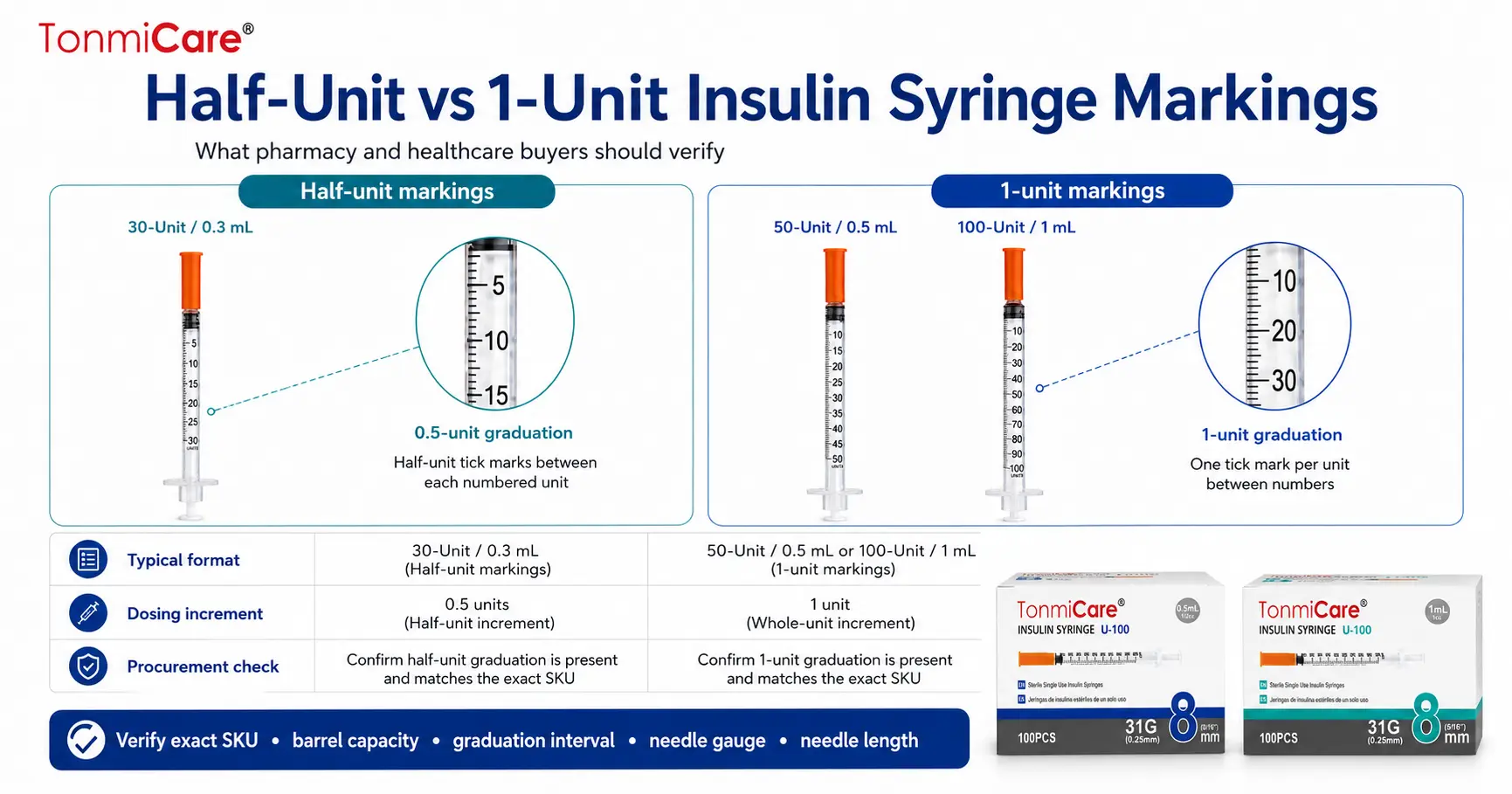
A half unit insulin syringe has a smallest labeled graduation of 0.5 insulin unit. A 1-unit syringe has a smallest labeled graduation of 1 insulin unit on its declared concentration-specific scale.
Graduation is only one product field. It does not identify barrel capacity, concentration scale, needle gauge, needle length, safety design, package count or overall measurement performance. A buyer should verify the exact manufacturer reference, current label and actual barrel scale before approving a product or substitution. FDA’s K212499 summary, for example, lists both 1-unit and half-unit increments within the referenced 0.3 mL U-100 syringe family.[1]
Executive summary
Key Takeaways for Pharmacy and Distributor Buyers
- Half unit is a graduation interval—not a barrel volume. It must not be confused with 0.5 mL capacity.
- Do not infer markings from capacity. Selected 0.3 mL products have half-unit markings; other 0.3 mL products use 1-unit markings, and a current GUDID record also identifies a 0.5 mL half-unit product.[4]
- Finer graduation is not proof of “twice the accuracy.” The scale interval is visible; complete performance depends on the exact design, tolerances and supporting evidence.
- Do not recreate a half-unit marking by estimation. A 1-unit device should not be represented in procurement materials as equivalent to a labeled half-unit device.
- Control the exact SKU. Concentration scale, capacity, graduation, gauge × length, design, REF, sterile presentation and pack hierarchy belong in the item master and purchase order.
- Keep human-use and veterinary products separated. A similar-looking U-40 or veterinary product does not establish equivalence to a U.S. human-use U-100 product.
1. Half-Unit vs 1-Unit Insulin Syringe Markings Comparison
The useful purchasing comparison begins with the smallest labeled scale division and then separates every other identity field. Do not compare price until the supplier quotes the same complete specification.
| Comparison field | Half-unit marking | 1-unit marking | Buyer control |
|---|---|---|---|
| Smallest labeled graduation | 0.5 insulin unit on the declared scale | 1 insulin unit on the declared scale | Verify the current label, barrel and exact REF |
| Barrel capacity | Not defined by the graduation | Not defined by the graduation | Record nominal mL capacity separately |
| Concentration scale | Must be identified for the product | Must be identified for the product | Do not interchange U-40 and U-100 systems |
| Measurement capability | Provides a printed 0.5-unit increment | Provides a printed 1-unit increment | Do not call visual midpoint estimation equivalent |
| Accuracy claim | Finer marked interval; exact performance remains product specific | Whole-unit marked interval; exact performance remains product specific | Review applicable testing and specifications |
| Needle configuration | Gauge, length and design vary by REF | Gauge, length and design vary by REF | Specify gauge × length and standard or safety design |
| Substitution status | Not automatically interchangeable | Use an approved alternate or written exception process | |
| Receiving requirement | Inspect the physical scale, label, REF and package hierarchy | Quarantine any mismatch or changed artwork | |
Procurement rule
“0.3 mL, 31G × 6 mm” is not a complete insulin syringe description. It still omits the concentration scale, maximum marking, graduation, device design, manufacturer REF and package identity.
2. A Half Unit Is Not the Same as 0.5 mL
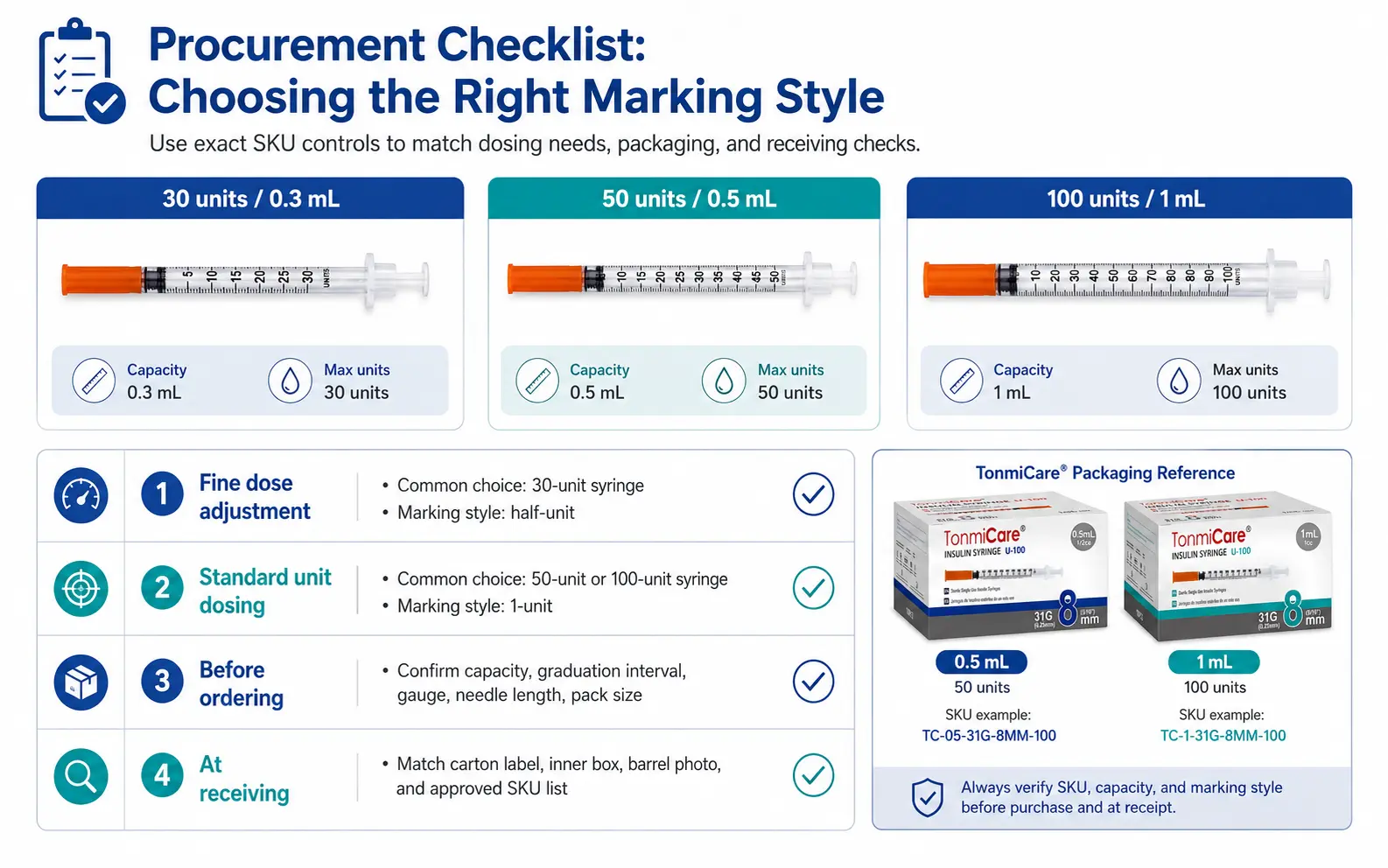
The words look similar but describe different dimensions. “Half unit” means a 0.5-unit increment on the syringe’s declared insulin scale. “0.5 mL” means the nominal liquid capacity of the barrel. A 0.5 mL U-100 syringe ordinarily has a maximum 50-unit scale, but its smallest graduation still depends on the exact product.
The distinction is not theoretical. AccessGUDID identifies a commercially distributed VanishPoint model as a 0.5 mL insulin syringe with half-unit markings.[4] FDA’s K190054 summary, by contrast, lists a referenced product family with 0.3 mL models in 1-unit and half-unit increments, 0.5 mL models in 1-unit increments and 1 mL models in 2-unit increments.[2] These are examples of identified product families—not universal rules for every manufacturer.
0.5 unit
The value represented by the smallest printed division on a half-unit scale.
1 unit
The value represented by the smallest printed division on a 1-unit scale.
0.3 mL
A nominal barrel volume; selected U-100 products may be marked to 30 units.
0.5 mL
A nominal barrel volume; it does not mean the syringe has half-unit markings.
3. Separate Scale, Capacity, Maximum Marking and Graduation
Pharmacy catalogs often compress several attributes into one short title. The item master should expand them again. Each field answers a different question and should be independently controlled.
Concentration scale
Identifies the insulin concentration system represented by the printed unit scale, such as U-100 or U-40.
Nominal barrel capacity
Identifies liquid volume, such as 0.3 mL, 0.5 mL or 1 mL.
Maximum unit marking
Identifies the highest numbered value on the applicable concentration-specific scale.
Graduation interval
Identifies what the smallest adjacent scale division represents: 0.5 unit, 1 unit, 2 units or the exact labeled interval.
For explanatory purposes only, U-100 means 100 units per milliliter. The mathematical volume corresponding to 1 U-100 unit is 0.01 mL, and the volume corresponding to 0.5 U-100 unit is 0.005 mL. This relationship explains why a half-unit mark is not a half-milliliter mark. It is not a direction to convert a prescription, use a mismatched syringe or measure another drug.
Buyers needing a broader capacity comparison can review the 0.3 mL, 0.5 mL and 1 mL insulin syringe sizes guide. For scale identity and non-interchangeability, use the separate U-40 and U-100 insulin syringe comparison.
4. What the Printed Markings Establish—and What They Do Not
A controlled label or barrel drawing can establish the printed scale format. It can show the concentration scale, highest marked value, numbered major marks and the smallest graduation. It cannot, by itself, establish every other characteristic of the device.
| Evidence item | May establish | Does not establish by itself |
|---|---|---|
| Controlled barrel artwork | Printed line arrangement, numbers and applicable scale legend | Commercial availability, shelf life or package count |
| Product label | Named product, capacity, selected specifications, manufacturer or labeler and warnings | Every underlying test result or unlisted alternate configuration |
| Public 510(k) summary | Scope and characteristics stated for the referenced submission | That every product using a similar trade name is covered |
| GUDID record | Basic identity information submitted for the identified device | Clinical superiority or automatic equivalence to another DI |
| Distributor catalog | Current listing details, manufacturer number and commercial pack data | Regulatory authorization for a different model or private label |
5. Finer Graduation Does Not Mean “Twice as Accurate”
Moving from a 1-unit interval to a 0.5-unit interval doubles the number of printed increments over the same unit range. It does not automatically halve every source of measurement error or prove twice the complete-device accuracy.
Overall performance can be influenced by scale geometry, line width, barrel diameter, plunger and stopper design, zero position, delivered-volume tolerances, dead space, manufacturing controls and the applicable test method. The correct buyer-facing statement is that a half-unit scale provides a labeled 0.5-unit measurement increment. Any additional accuracy, precision or performance claim must be supported for the exact product.
Do not use midpoint estimation as a product feature
A procurement guide should not tell readers that a 1-unit syringe becomes a half-unit device by positioning the plunger halfway between two lines. When an authorized workflow requires a labeled 0.5-unit increment, source and verify the appropriate exact SKU.
6. What Current Product Evidence Shows
Current public records demonstrate product variation and help disprove broad capacity assumptions. They should be used as identified examples, not as a national sales ranking or proof of Tonmit inventory.
0.3 mL: two graduation options
The summary lists 1-unit and half-unit increments for the referenced 0.3 mL U-100 family.[1]
0.3 mL half-unit example
A Sure Comfort DI describes a 0.3 mL, 31G × 8 mm insulin syringe with half-unit measure.[3]
0.5 mL half-unit example
A VanishPoint DI describes a 0.5 mL, 30G × 3/16-inch safety insulin syringe with half-unit markings.[4]
embecta’s current U.S. SafetyGlide page separately notes that its 0.3 mL presentation is available with a half-unit scale mark.[5] McKesson’s current catalog also identifies specific UltiCare 0.3 mL and VanishPoint 0.5 mL products as U-100 half-unit-scale configurations, with different gauge, length, safety design and case pack details.[6] The comparison proves why “half-unit insulin syringe” must be completed with the full REF-level specification.
Tonmit’s current 0.3 mL insulin syringe options page states that selected product references may support finer graduation options and instructs buyers to confirm the actual interval by SKU. Tonmit’s wholesale insulin syringe configurations page similarly presents a half-unit option for review by SKU. Neither page should be read as a promise that every listed 0.3 mL configuration has half-unit markings or is available in every market or lot.
7. Build the Purchase Description Around the Exact SKU
“Half-unit syringe” is a search term, not a complete purchase specification. Convert it into a controlled item description before requesting case pricing.
FDA explains that the device identifier portion of a UDI identifies the labeler and specific version or model, while production identifiers may include lot, serial number, expiration date or manufacture date when present on the label.[7] Use the applicable identifiers to support—not replace—the manufacturer REF, controlled label and package hierarchy in the item master.
8. Verify the Actual Barrel Artwork
Product photography can be useful for screening, but it is weak primary evidence for graduation approval. Perspective, glare, compression, low resolution and image retouching can hide minor lines or make unequal lines appear equal. AI-generated syringe images may create physically impossible scales or repeat numbers.
- Request the current controlled barrel drawing, label or high-resolution sample image for the exact REF.
- Identify the smallest adjacent interval, not only the numbered major marks.
- Confirm the concentration legend and maximum marking on the same product.
- Match the artwork revision to the approved sample, quotation and purchase order.
- Treat changed line spacing, line length, numbering or printing as a review trigger.
9. Should Half-Unit Syringes Be Stocked or Special-Ordered?
There is no universal stocking answer. Half-unit demand may be routine in one pharmacy network and rare in another. Build the decision from exact-SKU dispensing or consumption data, special-order requests, lead time, fill rate, expiry exposure and the consequences of an unavailable approved product.
| Tier | When it fits | Control | Review trigger |
|---|---|---|---|
| Core stock | Repeated local demand for one approved half-unit REF | Min/max or reorder-point replenishment | Monthly service level, expiry and stockout review |
| Secondary stock | Stable but lower demand across a pharmacy group | Central stock or hub-and-spoke transfer | Quarterly transfer and lead-time analysis |
| Special order | Infrequent, product-specific or market-specific requirement | Order against a confirmed need | Repeated emergency requests or service failure |
| Non-substitutable | Graduation or scale is a mandatory approved attribute | Hard block unless formally approved | Formulary, label, REF or supplier change |
Tonmit’s insulin syringe inventory controls guide provides a broader framework for scale, capacity, graduation, pack, lot and expiry data. Use local movement rather than a supplier’s generic “most popular” claim to decide which REF belongs in each tier.
10. Half-Unit and 1-Unit SKUs Are Not Automatic Substitutes
Two products can share brand, capacity, needle gauge, needle length and box quantity while using different barrel graduations. A system that groups them under one generic description may allow the wrong scale to be ordered, picked, received or dispensed.
Compare the mandatory fields
Scale, capacity, maximum marking, graduation, gauge × length, design, REF and pack must be reconciled.
Determine who may approve
Apply prescription, formulary, professional, payer, institutional and local requirements.
Document the decision
Record the approved alternate, scope, approver, date, reason and effective period.
Communicate and verify
Update purchasing, warehouse, dispensing, shelf labels and receiving controls together.
Fields that must not be silently changed
Concentration scale, graduation, maximum marking, needle configuration, safety mechanism, manufacturer REF, sterile presentation and package quantity should not be changed merely because a quotation describes the product as “equivalent.”
11. Create the Backorder Workflow Before a Shortage
Urgency is when uncontrolled substitutions are most likely. Build a preapproved workflow while inventory is available.
- Confirm the affected REF, available quantity, lot, expiration and expected recovery date.
- Search the approved-alternate list for the same required concentration scale and graduation.
- Compare capacity, gauge × length, design, labeling, package hierarchy and documentation.
- Escalate any graduation change instead of treating it as an ordinary supplier substitution.
- Document the temporary decision, customer or facility communication and end date.
- Restore the standard SKU deliberately; do not let a temporary alternate become permanent by default.
12. Keep Human-Use and Veterinary Syringes in Separate Review Paths
Searches for half-unit insulin syringes frequently return veterinary products, including U-40 configurations. Similar capacity, needle dimensions or a half-unit claim does not establish the same concentration scale, intended use, market status or labeling as a human-use product.
- Identify the intended market and product labeling before comparing specifications.
- Keep U-40 and U-100 item masters, shelf locations and substitution rules separate.
- Do not transfer a veterinary retailer’s claims to a human-use pharmacy listing.
- Do not use cap color or general product appearance as the primary scale control.
- Match regulatory records to the exact legal manufacturer, device and market.
13. Standard and Safety Insulin Syringes Need Separate Evaluation
Graduation does not identify whether a syringe includes an engineered sharps protection feature. Standard fixed-needle and safety insulin syringes require separate product records. For employee-use environments, the safety mechanism, activation, training and disposal workflow should be evaluated in addition to the measurement scale.
OSHA’s Bloodborne Pathogens standard requires engineering and work-practice controls to eliminate or minimize occupational exposure and requires annual consideration and implementation of appropriate commercially available and effective safer medical devices in the exposure-control plan.[8] That requirement does not make every retail insulin syringe a safety device. Verify the exact engineered feature and intended workplace use.
| Product type | Core marking controls | Additional buyer review |
|---|---|---|
| Standard fixed-needle syringe | Scale, capacity, graduation, gauge × length and REF | Sterile barrier, package, label, lot, expiry and intended workflow |
| Safety insulin syringe | All standard measurement and identity fields | Safety mechanism, activation, training, employee-use evaluation and sharps workflow |
14. Compare MOQ, Case Packs, Shelf Life and Landed Cost After the SKU Is Frozen
A cheaper case can contain fewer usable syringes, a different graduation or a shorter remaining shelf life. Normalize commercial quotations only after the exact product fields match.
Per exact graduation
Ask whether half-unit and 1-unit configurations have separate minimums.
Every packaging level
Record each, pouch or bag, box, case and pallet counts rather than “one case.”
Product-specific evidence
Request total shelf life and minimum remaining shelf life at receipt for the quoted REF.
Accepted units, not case price
Include freight, duties where applicable, damage, shortages and unusable short-dated stock.
For U.S. warehouse supply, confirm the exact REF, current available quantity, assigned lot, expiration date, order cut-off, destination and processing plan before relying on a delivery estimate. Warehouse location or a general product category does not guarantee that a half-unit configuration is physically in stock.
15. Receiving Inspection Checklist
The receiving team needs enough information to distinguish the approved SKU from a nearby configuration. Include the following fields on the purchase order, receiving worksheet or approved-item record.
- Concentration scale: verify U-40, U-100 or the exact labeled system.
- Capacity and maximum marking: reconcile mL capacity and highest unit value.
- Graduation: count and confirm the smallest labeled interval on the actual barrel.
- Needle: verify gauge, metric and inch length where stated, fixed design and safety status.
- Identity: match legal manufacturer, labeler or brand, manufacturer REF and applicable DI/GTIN.
- Package hierarchy: confirm individual presentation, units per box and boxes per case.
- Production data: capture lot, expiration date and manufacturing date where labeled.
- Packaging condition: inspect sterile barrier, carton integrity and shipment damage.
- Revision: compare current label and barrel artwork with the approved version.
- Disposition: release matching stock; quarantine and investigate any discrepancy.
16. Match Supplier Documents to the Exact Product
A general brochure, establishment registration or certificate bearing a familiar company name is not enough to approve a particular half-unit SKU. FDA states that establishments involved in production and distribution may need registration and device listing, and that a premarket submission number is also supplied when a device requires marketing authorization.[9] These are distinct records and should not be described interchangeably.
FDA’s K212499 letter uses the decision “substantially equivalent.” It also explains that the determination does not mean FDA has determined compliance with every other applicable requirement.[1] Use “510(k) cleared” or the exact database decision where applicable—not the unsupported phrase “FDA certified.”
| Document or record | What to match | Common error |
|---|---|---|
| Product specification | Scale, capacity, graduation, needle, design, REF and revision | Using a family brochure for every model |
| Label and IFU | Intended use, symbols, warnings, manufacturer and exact product | Approving from an e-commerce image |
| 510(k) record where applicable | Applicant, device name, product code, models and cited scope | Calling registration or listing a 510(k) clearance |
| UDI/GUDID information where applicable | Labeler, brand, version or model, device count and DI | Applying one DI to another package level or model |
| Sterility and shelf-life information | Exact device and packaging configuration | Assuming another REF has the same validated shelf life |
| Lot and transaction records | PO, quantity, lot, expiry, shipment and receiving record | Keeping product approval separate from the received lot |
Tonmit’s exact-SKU documentation review explains how product, manufacturer, model and transaction records should form one evidence chain.
17. Copyable Half Unit Insulin Syringe RFQ
Replace every bracketed field. If the graduation is mandatory, state it as a controlled requirement and keep the no-substitution instruction visible.
Half Unit Insulin Syringe — Buyer RFQ
Product: Insulin syringe, sterile, single use
Intended market: [United States / other defined market]
Concentration scale: [U-100 / U-40 / exact labeled requirement]
Capacity and maximum marking: [0.3 mL / 30 units, or exact requirement]
Graduation: 0.5-unit smallest labeled increment
Needle: [gauge] × [length in mm and inches], [fixed needle / approved safety design]
Primary presentation: [individual sterile barrier / exact configuration]
Commercial pack: [units/box] × [boxes/case] = [units/case]
Identity: [legal manufacturer] / [brand or labeler] / [manufacturer REF] / [UDI or GTIN where applicable]
Documentation: Current product specification, controlled label/IFU, applicable regulatory records, sterility and shelf-life information
Acceptance: Minimum remaining shelf life [__ months]; lot and expiration confirmed before shipment
Quantity: Trial [__ cases]; monthly [__ cases]; annual forecast [__ cases]
Delivery: Destination ZIP/country [_____]; requested date [_____]
Substitution: No change to scale, graduation, capacity, needle, design, manufacturer, REF, package or label without prior written approval
Buyer FAQ
Frequently Asked Questions About Half-Unit Insulin Syringes
What is a half unit insulin syringe?
It is an insulin syringe whose smallest labeled graduation represents 0.5 insulin unit on the declared concentration-specific scale. The term does not identify capacity, gauge, length, manufacturer or package quantity.
What do 1-unit insulin syringe markings mean?
They mean the smallest adjacent labeled scale division represents 1 insulin unit on the declared scale. Confirm the actual barrel artwork because numbered major marks and smallest divisions are not the same thing.
Is a 0.5 mL syringe the same as a half-unit syringe?
No. 0.5 mL describes nominal barrel capacity. Half unit describes the graduation interval. A buyer must verify both fields independently.
Do all 0.3 mL insulin syringes have half-unit markings?
No. FDA’s K212499 summary lists both 1-unit and half-unit increments for the referenced 0.3 mL family. Capacity alone cannot identify the graduation.[1]
Can a 1-unit syringe be treated as a half-unit syringe?
It should not be represented as equivalent merely by asking a user to estimate the midpoint between printed lines. If a labeled 0.5-unit increment is required, source and verify an exact product that provides it.
Are half-unit syringes twice as accurate?
That conclusion is not supported by the marking interval alone. A half-unit scale provides twice as many printed increments over the same unit range, but complete-device accuracy and performance remain product and test specific.
Are half-unit markings available only on 0.3 mL syringes?
Can U-40 and U-100 half-unit syringes be interchanged?
No. The concentration-specific scales represent different volume relationships. Match the syringe scale to the exact insulin label and authorized direction; do not use graduation similarity as a conversion method.
Does needle gauge or length determine the graduation?
No. Gauge, needle length, capacity, concentration scale and graduation are separate SKU fields. The same gauge × length description may appear on different syringe configurations.
Can pharmacies automatically substitute half-unit and 1-unit syringes during a shortage?
No automatic interchangeability should be assumed. Apply the prescription, current label, formulary, professional review, payer requirements, institutional policy and applicable law, then document any approved alternate.
What should be checked when receiving half-unit insulin syringes?
Verify concentration scale, capacity, maximum marking, smallest graduation, needle specification, safety design, manufacturer, REF, identifiers, package hierarchy, label revision, lot, expiration and sterile-barrier condition.
What should buyers include in a wholesale quote request?
Include the full scale, capacity, graduation, gauge × length, standard or safety design, manufacturer and REF requirements, sterile presentation, box/case structure, quantity, destination, shelf-life requirement, documents and substitution rule.
18. Conclusion: Buy the Graduation as a Controlled SKU Field
Half-unit and 1-unit markings answer one precise question: what does the smallest printed division represent? They do not answer the rest of the purchasing specification.
A controlled buying process separates concentration scale, barrel capacity, maximum marking, graduation, gauge × length, standard or safety design, manufacturer REF, sterile presentation, package hierarchy, identifiers, lot, expiration and label revision. It verifies the actual barrel artwork, blocks unapproved substitutions, prepares a shortage workflow and reconciles the received lot to the approved item. That is the difference between purchasing a generic “half-unit syringe” and purchasing a traceable, replenishable exact SKU.
Source basis
Official and Product-Specific Sources Used for This Guide
- FDA — K212499, BD Insulin Syringe (0.3 mL), 510(k) Summary. The file lists 1-unit and half-unit scale increments for the identified 0.3 mL U-100 family.
- FDA — K190054, BD Insulin Syringe, 510(k) Summary. The file separates capacity, scale markings, gauge, length and packaging characteristics for the referenced family.
- AccessGUDID — Sure Comfort, DI 00786227650456. The device description identifies a 0.3 mL, 31G × 8 mm insulin syringe with half-unit measure.
- AccessGUDID — VanishPoint, DI 00613703153906. The device description identifies a 0.5 mL insulin syringe with half-unit markings.
- embecta — BD SafetyGlide 6 mm Insulin Syringe. The current U.S. page notes 0.3 mL availability with a half-unit scale mark.
- McKesson — UltiCare 0.3 mL Half-Unit Scale Listing; McKesson — VanishPoint 0.5 mL Half-Unit Safety Syringe Listing. Used as current commercial catalog examples, not regulatory evidence for other SKUs.
- FDA — UDI Basics. Describes DI, PI and GUDID identity concepts.
- OSHA — Bloodborne Pathogens and Needlestick Prevention Standards. Describes engineering and work-practice control requirements for occupational exposure.
- FDA — Device Registration and Listing. Used to distinguish establishment registration, device listing and premarket submission information.
Links and supporting statements were reviewed on August 21, 2026. Product portfolios, commercial availability, labels and regulatory records can change. Reconfirm the exact SKU, current label, destination market and transaction-specific requirements before a future purchase or revision.
Exact-SKU Insulin Syringe Procurement Support
Review a Half-Unit Insulin Syringe Requirement
Share the required concentration scale, capacity, maximum marking, graduation, gauge × length, estimated volume, destination, packaging and documentation needs. Tonmit can review selected product configurations, U.S. warehouse-supported options and project-specific supply terms by SKU.