
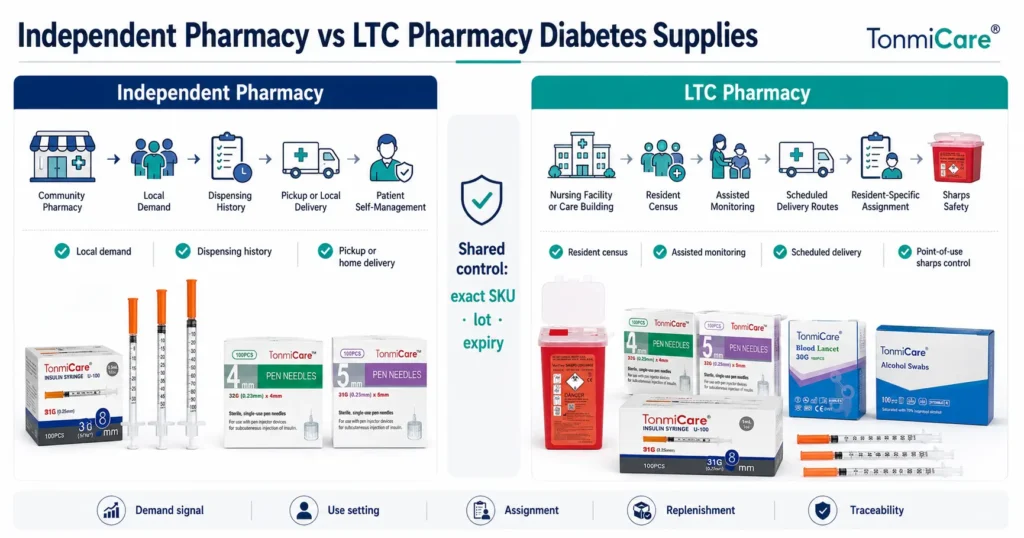
Pharmacy Inventory & LTC Supply Planning Guide
A procurement comparison for pharmacies planning diabetes injection, blood glucose monitoring and sharps-management supplies across community retail and long-term care workflows—covering demand signals, resident assignment, assisted monitoring, replenishment, delivery and traceability.
Scope: This guide addresses U.S. B2B purchasing and replenishment of finished diabetes-care devices and consumables. It does not select a product for an individual resident, replace a prescription or care plan, establish Medicare coverage, define every state pharmacy or facility requirement, or determine a facility’s infection-control policy. Verify the exact product labeling, authorized order, payer rules, supplier status, state law, facility policy and contract before purchasing or substitution.
Direct answer
Should Independent and LTC Pharmacies Stock the Same Diabetes Supplies?
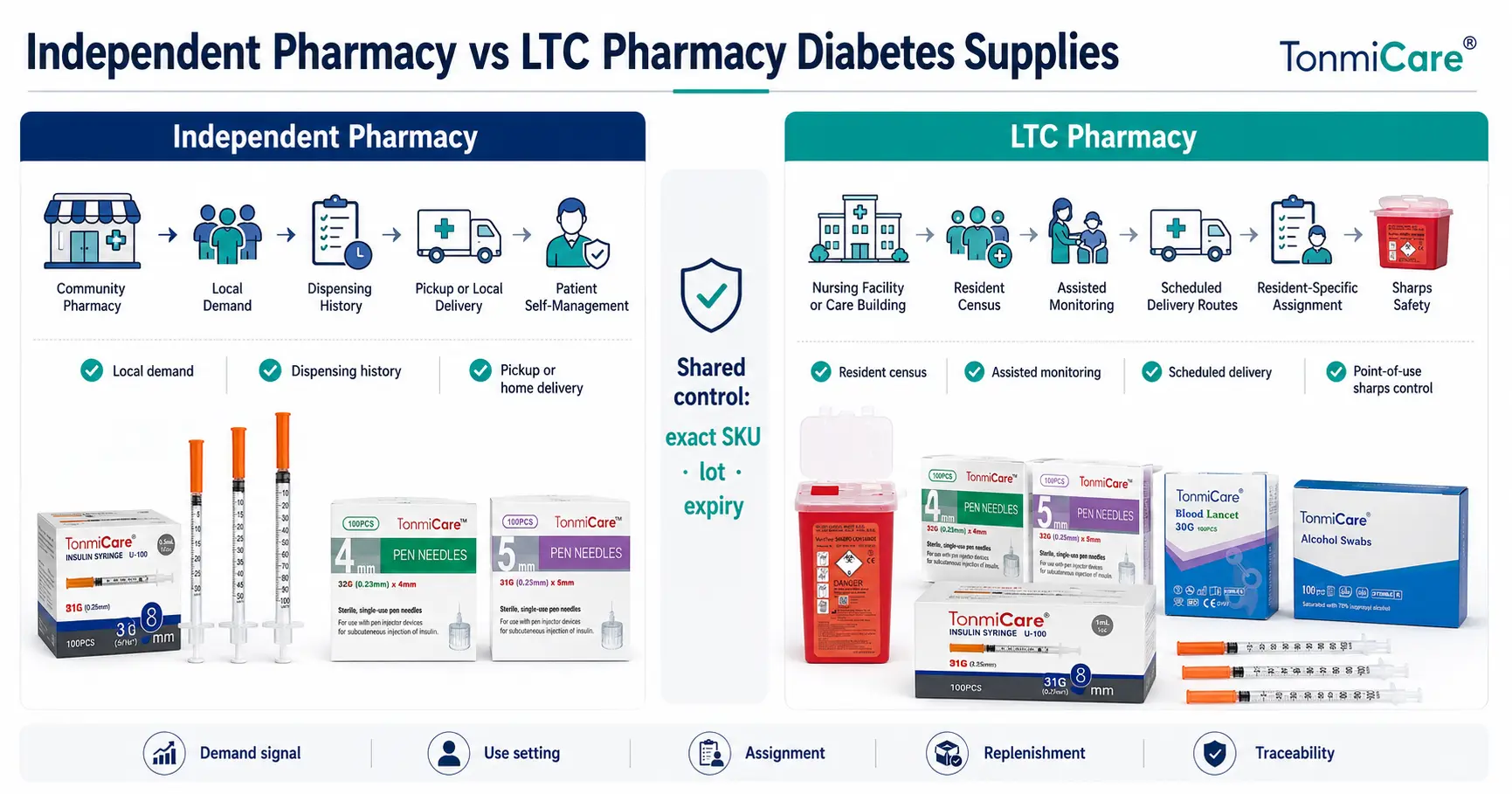
They may purchase many of the same product categories, but they should not use the same inventory, safety, delivery or replenishment model. An independent community pharmacy commonly plans around local patient demand, prescription and sales history, self-management products, pickup or home delivery, and a core-stock-versus-special-order decision. A long-term care pharmacy must also coordinate resident census, authorized orders, admissions and discharges, facility delivery routes, assisted blood glucose monitoring, resident-level assignment, after-hours needs and facility procedures.
The correct comparison is therefore not “which pharmacy needs more products?” It is “which demand signal, user, location and control record governs each exact SKU?” A blood glucose meter, lancing system, insulin syringe, pen needle or sharps container can require a different purchasing decision when it moves from patient self-use to staff-assisted use in a congregate care setting.
Start with scope
Independent Pharmacy and LTC Pharmacy Describe Different Operating Contexts
An independent pharmacy is generally defined by ownership, but ownership alone does not determine its service model. For this guide, “independent pharmacy” means a community pharmacy that primarily supplies individual patients through retail dispensing, counter sales, special orders or local delivery. It may still serve facilities or operate additional programs.
“Long-term care pharmacy” is used here to describe a pharmacy service model supporting residents and facilities such as nursing facilities or other contracted care settings. The pharmacy may be independently owned, part of a regional group or part of a national organization. What changes is the service context: facility coordination, resident records, scheduled delivery, new admissions, emergency medication access and other contract-defined responsibilities.
An independent pharmacy can provide LTC services when it has the required licenses, contracts, systems and operational capacity. Conversely, an LTC pharmacy does not automatically control every diabetes consumable used inside a facility. Responsibility may be divided among the pharmacy, facility, resident, prescriber, payer and another DME or medical-supply provider.
Operating model
Independent Pharmacy vs LTC Pharmacy Diabetes Supplies Comparison
The table separates the recurring procurement decisions. It is a planning framework—not a statement that every independent or LTC pharmacy follows one identical process.
| Dimension | Independent community pharmacy | Long-term care pharmacy | Buyer control |
|---|---|---|---|
| Primary demand signal | Dispensing history, POS movement, refill patterns, local prescriber and patient demand | Active residents, authorized orders, monitoring or administration events, admission/discharge activity and route timing | Do not use one forecast model for both channels |
| Typical use | Patient self-management or caregiver-supported home use | Resident self-use, staff-assisted monitoring or staff administration under facility procedures | Confirm user and setting before product selection |
| Meter strategy | Patient-specific retail system with continuing strip availability | Resident-dedicated meter whenever possible; professional-use device and validated cleaning workflow if shared | Match meter, strip, control material and intended setting |
| Fingerstick device | Personal reusable lancing device or single-use product as appropriate | Single-use, auto-disabling device for assisted monitoring | Never share a fingerstick device between people |
| Injection supply | Exact prescribed or requested syringe or compatible pen needle | Exact resident supply plus facility exposure-control and workflow considerations | No unapproved capacity, scale, needle or connector substitution |
| Packaging | Finished retail or prescription package; patient order label where applicable | Finished product identity plus resident, facility, unit, tote or delivery-route control as applicable | Do not treat device packaging as drug unit-dose packaging |
| Service level | Retail hours, local delivery schedule and wholesaler lead time | Contract-defined scheduled, new-admission, after-hours and emergency support | Write response times and exclusions into the agreement |
| Traceability | SKU, lot, expiration, received quantity and patient transaction where applicable | SKU, lot and expiration plus facility, resident/unit assignment, delivery and return status as applicable | Design recall retrieval before purchasing |
| Cost unit | Cost per sellable or dispensed unit and inventory turn | Usable cost per resident/service cycle plus route, shortage and expiration exposure | Compare landed, usable cost—not carton price alone |
Control before quantity
Separate Four Diabetes Supply Ownership Buckets
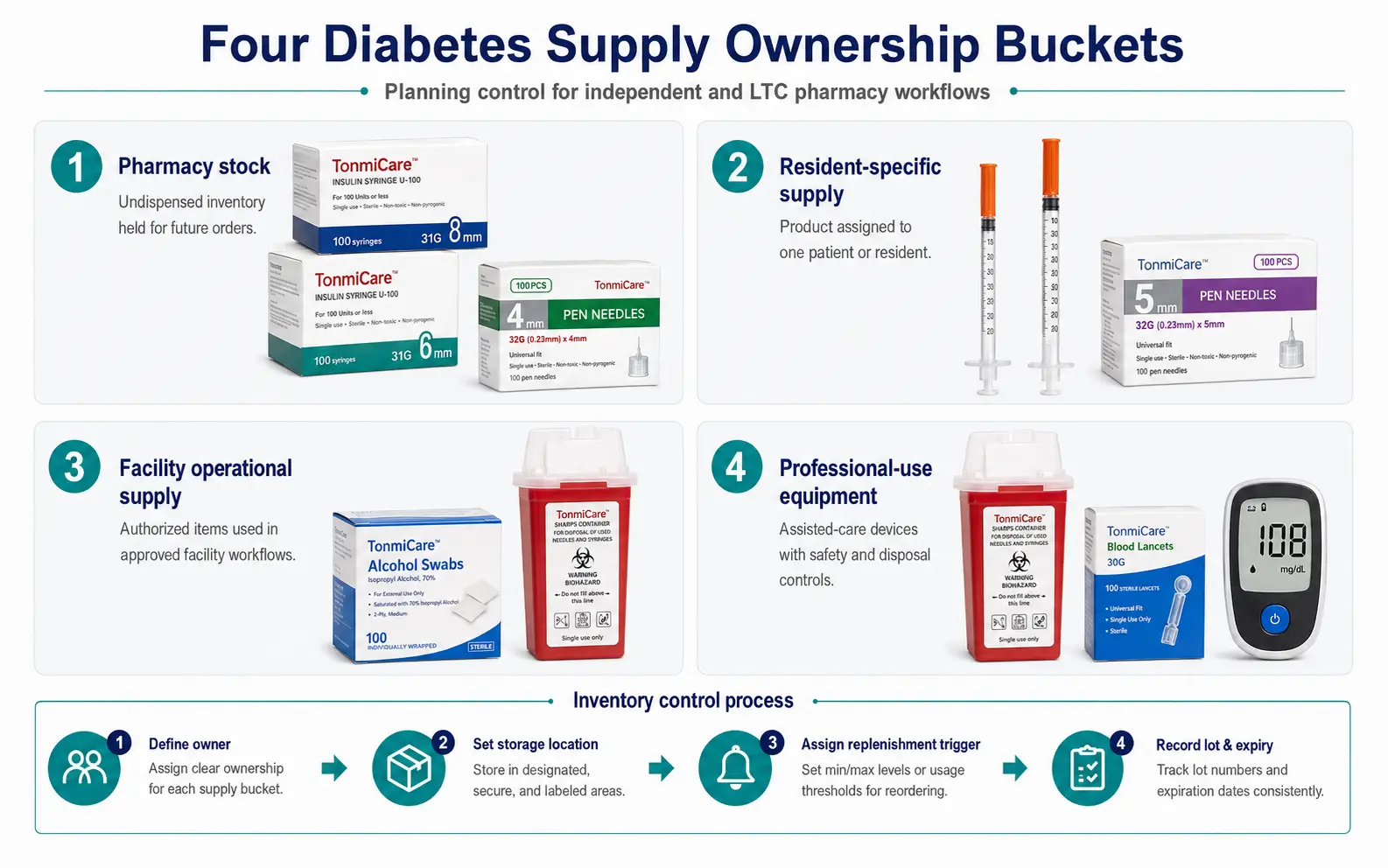
A large share of LTC inventory errors begins before the reorder calculation: the buyer has not defined who owns the product and who is responsible for replenishing it. The same box of lancets or pen needles can appear in four different control states.
Pharmacy stock
Undispensed inventory held for future orders. The pharmacy controls purchasing, FEFO, lot records and reorder points.
Resident-specific supply
Product assigned or dispensed to one resident. Identity, quantity, location and refill status should remain visible.
Facility operational supply
Items the facility is authorized to maintain for an approved workflow. Ownership and replenishment must be defined by policy and contract.
Professional-use equipment
Meters or other equipment used in assisted care, with cleaning, disinfection, assignment and maintenance controls.
Do not use “floor stock” as a catch-all phrase. For each category, name the owner, authorized user, storage location, issue record, replenishment trigger and disposition rule. This prevents duplicate supply during an admission, unrecorded transfer between units and disputes over who must replace a depleted product.
Community pharmacy model
What Independent Pharmacies Commonly Stock or Special-Order
An independent pharmacy generally benefits from a compact core assortment supported by controlled special ordering. The right assortment depends on real local demand rather than the number of available brands. Tonmit’s diabetes supplies stocking guide provides a broader category-level stock-versus-special-order framework.
| Planning tier | Potential categories | Stocking reason | Primary risk |
|---|---|---|---|
| Core recurring | Locally requested syringe and pen-needle SKUs, prep pads, selected lancets and compatible high-turn monitoring supplies | Repeat demand and short acceptable wait time | Confusing similar capacities, scales, gauges, lengths or packs |
| Conditional stock | Additional strip systems, control solutions, sharps containers, safety products and selected accessories | Recurring demand exists but is concentrated by brand, device or patient group | Slow turnover, compatibility error and expiration |
| Special order | Low-frequency sizes, device-specific pump/CGM items, unusual packaging or payer-dependent products | Demand is identifiable but too variable for broad shelf stock | Patient wait time and supplier backorder |
A productive independent-pharmacy assortment does not attempt to keep every test-strip or injection SKU. It keeps a defined service level for proven local demand, preserves a fast special-order path and records lost sales or unfilled requests so the next review is evidence-based.
Facility service model
What Changes in the LTC Pharmacy Diabetes Supply Model
LTC supply planning starts with residents and workflows rather than retail shelf breadth. The pharmacy should identify which residents need which exact products, which items are provided through another benefit or supplier, which tasks are performed by facility staff, and which service events must be supported between scheduled deliveries.
- Resident rosterActive resident, facility, unit, room or other approved location identifier.
- Authorized supply recordExact product, quantity basis, effective date and applicable order or care-plan reference.
- Use settingResident self-management, staff-assisted monitoring or staff-administered injection.
- Source responsibilityLTC pharmacy, facility, resident/family, health plan, DME supplier or another contracted provider.
- Route calendarScheduled delivery, order cutoff, receiving location, after-hours escalation and holiday coverage.
- Transition statusNew admission, temporary leave, hospital transfer, room/unit move, therapy/device change or discharge.
42 CFR §483.45 requires a nursing facility to provide pharmaceutical services that assure accurate acquiring, receiving, dispensing and administering of drugs and biologicals and to provide routine and emergency drugs. That rule establishes an important LTC systems context, but it should not be rewritten as a universal packaging or par-level rule for diabetes devices and consumables.
Assisted monitoring
Home Blood Glucose Supplies Cannot Be Copied Directly into LTC Workflows
A community pharmacy frequently supplies a personal meter system for self-monitoring: one meter, compatible strips, a personal lancing device, matching lancets and any applicable control material. An LTC facility may have both resident self-testing and staff-assisted monitoring, and the two workflows need different controls.
CDC recommends assigning blood glucose meters to one person whenever possible. If a meter must be shared in a healthcare or congregate setting, CDC says to select a device designed for professional use—not an over-the-counter device—and clean and disinfect it after every use according to the manufacturer’s instructions. If the manufacturer does not provide suitable cleaning and disinfection instructions, the meter should not be shared.
Personal-use system
Independent pharmacy or resident-dedicated supply
- Meter assigned to one person
- Exact compatible test strips
- Compatible personal lancing device and lancets
- Control solution only when applicable to that system
- Storage and refill instructions tied to manufacturer labeling
Assisted-monitoring system
LTC professional workflow
- Resident-dedicated meter whenever possible
- Professional-use meter if sharing is unavoidable
- Single-use, auto-disabling fingerstick devices
- Approved cleaning and disinfection products and contact times
- Point-of-use sharps disposal and staff training
Meter, strip and control solution relationships are model-specific. Match the exact meter family, strip reference, control material, storage range, open-vial dating where applicable, lot/expiry and intended use using current manufacturer labeling. Use the diabetic testing supplies buying guide for a detailed system-level purchasing review.
Injection categories
Control Insulin Syringes and Pen Needles at Exact-SKU Level
The product family name is not enough for either pharmacy model. A purchase record for an insulin syringe should identify the concentration/scale relationship, capacity, graduation, needle gauge, needle length, fixed-needle configuration, package quantity and exact reference. A pen-needle record should identify the manufacturer, product family, gauge, length, connector design, safety format if applicable and package quantity.
| Product | Independent pharmacy focus | LTC pharmacy addition | Do not substitute without review |
|---|---|---|---|
| Insulin syringe | Exact prescribed/authorized capacity, scale, gauge, length and quantity | Resident identity, administration workflow, staff exposure controls and delivery quantity | Concentration/scale, capacity, graduation or needle specification |
| Pen needle | Verify that the injector uses an external needle and confirm compatibility | Resident-dedicated pen, storage/labeling workflow and occupational-exposure evaluation | Gauge, length, connector or conventional/safety format |
| Prep product | Pack size and intended preparation workflow | Facility policy, storage and event-level consumption | Product composition or intended use |
CDC states that insulin pens are single-patient devices and must never be used for more than one person, even when a new needle is attached. For broader category planning, review Tonmit’s diabetes injection supplies checklist, wholesale insulin syringe options and wholesale insulin pen needle options.
Worker and disposal controls
Sharps Planning Differs Between Home Supply and Facility Use
An independent pharmacy selling or dispensing home-use sharps products should provide or direct the patient to disposal information applicable to the product and locality. A facility workflow involves additional employer and regulated-waste controls. OSHA’s Bloodborne Pathogens Standard applies to employers with employees who have occupational exposure; it requires a written exposure-control plan and the use of engineering and work-practice controls to eliminate or minimize employee exposure.
OSHA defines engineering controls to include sharps disposal containers and safer medical devices. It also requires contaminated sharps containers to be closable, puncture resistant, leakproof on the sides and bottom, properly labeled or color-coded, accessible near the point of use, maintained upright and replaced before overfilling. Specific product selection must still follow the employer’s exposure determination, employee input, facility policy and applicable law.
Do not claim that every LTC resident or every injection task legally requires the same safety needle. The employer must evaluate effective engineering and work-practice controls for the tasks and exposures present. Procurement supports that process by providing exact product evidence, trial/evaluation quantities, compatible disposal capacity and a controlled substitution rule.
Review sharps containers and diabetes care accessories by intended setting, opening, capacity, mounting/placement method, fill indication, closure, carton quantity and disposal workflow—not by volume alone.
Demand signals
Use Different Forecast Inputs for Community and LTC Demand
Independent pharmacy forecasting is SKU-led. Start with units dispensed or sold by exact SKU, exclude one-time projects where appropriate, then adjust for supplier lead time, minimum order, seasonal or prescriber changes, promotion effects, backorders and documented lost demand. A short period of high sales caused by a competitor’s shortage should not automatically become the new baseline.
LTC forecasting is resident-and-event-led. Start with the authorized resident roster and the supply-consuming events supported by the pharmacy. Then adjust for remaining resident supply, route frequency, admissions, discharges, device changes, facility-approved contingency stock and pack rounding. Do not forecast solely from last month’s cartons if the facility census or responsibility split changed.
Quantity method
Build Reorder Rules Around the Actual Service Unit
A reorder point is useful only when every input uses the same unit. If demand is measured in individual pieces but purchasing is in boxes and receiving is in cases, the system must preserve the conversion at every step.
Average daily exact-SKU demand × replenishment lead time + safety stock
Convert the result to the supplier’s order unit and check expiration exposure before rounding.
Authorized events per resident/day × active residents × coverage days + approved contingency quantity
Subtract usable on-hand resident/facility supply, then adjust for admissions, discharges and route timing.
“Authorized events” must come from current orders, care records and facility workflow. It is not a clinical frequency recommended by this article. Establish separate rules for durable items, recurring consumables and cleaning/disinfection supplies because their replacement cycles are not interchangeable.
For commercial review, compare case price, box price and per-piece cost. For operational review, calculate the cost of units that can actually be issued before expiration. Tonmit’s MOQ, case pack and shelf-life planning guide covers these commercial conversions in more detail.
Handoff control
Separate Manufacturer Packaging from Resident and Route Identification
Diabetes devices and consumables should normally arrive with their finished product identity, lot and expiration information intact. LTC operations may add resident, facility, unit, tote, route or order identification as applicable, but the operational label should not obscure the manufacturer’s label or create unsupported product claims.
- Product levelManufacturer, model/REF, specification, sterile status where applicable, lot, expiration and package quantity.
- Resident/order levelAuthorized recipient, quantity, order status and resident-specific assignment where applicable.
- Facility handoff levelFacility, unit, delivery route, receiving point, tote/seal and temperature control when the product requires it.
- Inventory levelSellable or issue unit, inner pack, case conversion, storage location, FEFO sequence and recall record.
Do not automatically place pen needles, syringes, test strips or lancets into medication bingo cards or unit-dose systems. Drug packaging, medical-device packaging and operational order grouping are different functions. Opening a finished device package, repacking it or changing its label can create regulatory and quality responsibilities that require product-specific review.
Regulatory boundary
The Federal 14-Day LTC Dispensing Rule Is Not a Universal Supply Rule
42 CFR §423.154 requires Part D sponsors, subject to stated exclusions and waivers, to require pharmacies serving LTC facilities to dispense solid oral doses of brand-name Part D drugs in no greater than 14-day increments. The section addresses covered Part D drugs and unused drugs; it does not state that blood glucose strips, lancets, pen needles, insulin syringes or sharps containers must be dispensed in 14-day increments.
- Covered Part D drugs for LTC residents
- Solid oral doses of brand-name drugs
- Defined exclusions and waivers
- Uniform dispensing techniques and unused-drug provisions
- All diabetes consumables require 14-day quantities
- Every device belongs in medication cycle packaging
- Every facility uses the same supply delivery frequency
- Unused medical supplies follow the same return rule as drugs
Diabetes supply replenishment may still be coordinated with a facility’s medication cycle for operational convenience, but that is a workflow or contract decision—not a universal federal device requirement.
Service-level design
Define Scheduled, Admission and Emergency Supply Separately
An independent pharmacy usually plans against store hours, local delivery windows and wholesaler cutoffs. LTC service requires more explicit event categories. A normal route, a new admission, a damaged/missing package, an after-hours authorized need and a true emergency should not all use the same promised response time or pricing rule.
CMS’s long-standing LTC pharmacy guidance describes on-call and delivery capabilities for network LTC pharmacies and states that specific delivery arrangements are determined by agreement between the LTC pharmacy and facility. Because that guidance is from 2005 and focuses medication services, buyers should verify current plan, contract, state and facility requirements rather than copying its service frequencies into a diabetes-supply RFQ without review.
For inventory held domestically, confirm that “U.S. warehouse” means the exact SKU is available and free to sell—not merely that the supplier has a U.S. address. Review U.S. medical supply fulfillment by lot, expiration, available quantity, order cutoff, handling time, destination and upstream replenishment plan.
Census control
Admissions, Transfers and Discharges Must Change the Supply Plan
LTC demand can change before historical usage data shows the change. A new admission may require a starter quantity before the normal route. A hospital transfer can pause consumption. A device change can strand strips or control solution. A discharge can leave resident-specific stock that cannot simply be returned to general inventory.
| Event | Confirm | Inventory action | Common failure |
|---|---|---|---|
| Admission | Existing device, exact consumable, current on-hand quantity, source and authorized need | Issue controlled starter amount; avoid duplicating resident-owned supply | Sending a generic meter or needle before compatibility review |
| Internal transfer | Resident identity, new unit/location and custody | Move the record with the product; prevent second issue | Stock physically moves but remains assigned to the old unit |
| Hospital leave | Expected return and supply status | Pause or adjust the next replenishment as permitted | Automatic refill continues despite no consumption |
| Discharge | Ownership, package integrity, policy and disposition instructions | Stop replenishment and document disposition | Returning resident-specific products to shared inventory without authority |
Backorder discipline
Use a Written Diabetes Supply Substitution Matrix
A wholesaler backorder does not make the next available product equivalent. For every high-impact SKU, define who may approve a substitute, which attributes must remain identical and which changes require prescriber, pharmacist, facility, payer, training or resident-level review.
| Category | Exact-match controls | Potential downstream change |
|---|---|---|
| Meter system | Meter model, strip REF, control material, intended setting and unit of measure | New training, resident assignment, cleaning/disinfection and payer review |
| Insulin syringe | Concentration/scale, capacity, graduation, gauge, length and fixed-needle design | Reading, handling, order and administration risk |
| Pen needle | Connector, gauge, length, conventional/safety format and package quantity | Compatibility, technique/training and exposure-control change |
| Lancing product | Personal versus single-use auto-disabling design, depth setting and intended user | Infection-control and staff-safety change |
| Sharps container | Setting, opening, capacity, placement, closure and waste-stream compatibility | Point-of-use access, overfill risk and disposal workflow |
Where substitution is not pre-authorized, the supplier should provide the proposed exact SKU and evidence before shipment. “Same gauge,” “universal,” “comparable” or “professional quality” is not enough to establish equivalence.
Receiving and recall
Extend Lot and Expiration Control to the LTC Handoff
Both pharmacy models should receive against the purchase order and record the exact SKU, lot, expiration, quantity, condition and storage requirement. LTC operations also need to know where the product went after receiving. The depth of resident-level tracking depends on the product, transaction and applicable system, but the recall workflow should be able to narrow affected inventory beyond “one case was delivered to the facility.”
- ReceiveMatch manufacturer, REF, specification, pack hierarchy, lot, expiration, quantity and shipping condition.
- ReleaseConfirm the product is the approved version and has sufficient remaining shelf life for the planned service period.
- AssignConnect the issue or delivery record to the facility, resident/unit or approved stock location where applicable.
- RetrieveTest whether an affected lot can be located, quarantined, communicated and reconciled within the required response period.
FEFO—first expired, first out—is useful only when shorter-dated stock can still be consumed before expiration. Do not transfer short-dated inventory from a low-use independent pharmacy location to an LTC account unless the receiving demand, contract and remaining-shelf-life requirement support that decision.
Commercial vs benefit pathway
Do Not Treat Pharmacy Channel as Proof of Medicare Coverage
Medicare assigns diabetes products to different benefit pathways. Medicare states that Part B covers some blood glucose test supplies, including test strips, and covers lancets/lancet holders as DME supplies when applicable requirements are met. Its lancet page describes coverage for medically necessary DME prescribed for use in the home. Medicare also states that Part B covers insulin used with a covered durable insulin pump, while Part D plans may cover insulin and certain insulin-related supplies in other circumstances.
These pages do not mean that every pharmacy can bill every product, that every LTC resident’s place of care is treated the same as a home for every benefit, or that a commercial diabetes supply bundle is one covered item. Verify the resident, prescription, product, place of use, benefit, plan, network, supplier enrollment/participation and transaction before making a coverage statement.
Qualification evidence
Review the Supplier by Exact Product and Service Responsibility
A supplier that can ship a retail carton may not be able to support LTC route-level replenishment, resident-specific issue records or emergency service. Conversely, an LTC pharmacy service contract does not prove that every device SKU has been reviewed for its intended professional workflow. Qualification should cover both the product and the promised service.
Request documents that apply to the exact product and market, not a folder of unrelated corporate certificates. Tonmit’s exact-SKU documentation review page outlines the information buyers can request before commercial approval.
Inquiry preparation
Independent and LTC Pharmacy Diabetes Supply RFQ Checklist
A quote becomes comparable only when every supplier is asked to price the same product, service level and delivery responsibility.
Ask suppliers to quote one core high-turn SKU basket and one facility workflow basket separately. This exposes differences in case packs, service requirements and replenishment responsibility before the buyer combines them into a larger program.
Buyer FAQ
Independent vs LTC Pharmacy Diabetes Supplies: Frequently Asked Questions
What diabetes supplies should an independent pharmacy keep in stock?
Stock proven local high-turn exact SKUs, then support lower-frequency or device-specific items through a documented special-order process. Typical categories may include selected insulin syringes, pen needles, prep pads, lancets, test strips for locally used meter systems and sharps accessories. The final assortment should follow actual demand, compatibility, supplier lead time, shelf life and payer/channel requirements.
What diabetes supplies should an LTC pharmacy plan for?
Plan resident-specific injection and monitoring supplies, assisted-monitoring products, professional-use meters where applicable, single-use auto-disabling fingerstick devices, cleaning/disinfection supplies, point-of-use sharps containers and any contractually assigned facility supplies. Responsibility may be split among the pharmacy, facility, resident and another supplier, so the list must be account-specific.
Can an independent pharmacy provide LTC diabetes supplies?
Potentially, yes. Independent ownership does not prevent a pharmacy from serving LTC facilities. The pharmacy must be able to meet applicable licensing, contractual, clinical-support, technology, delivery, quality and service requirements. This guide does not determine eligibility for a specific facility or payer network.
Can a blood glucose meter be shared between LTC residents?
CDC recommends assigning meters to one person whenever possible. If sharing is necessary in a healthcare or congregate setting, select a device designed for professional use and clean and disinfect it after every use according to manufacturer instructions. If the manufacturer does not provide suitable instructions, do not share the meter.
Can a fingerstick or lancing device be shared?
No. CDC states that fingerstick devices should never be used for more than one person. In assisted monitoring, use single-use auto-disabling fingerstick devices and discard them at the point of use in an approved sharps container.
Can an insulin pen be shared if the needle is changed?
No. CDC states that insulin pens are single-patient devices and must never be used for more than one person because blood may be present in the pen after use.
Do diabetes supplies follow the federal 14-day LTC cycle-fill rule?
Not as a universal rule. The federal requirement in 42 CFR §423.154 addresses specified solid oral doses of brand-name Part D drugs for LTC residents and includes exclusions and waivers. It does not state that test strips, lancets, pen needles, syringes or sharps containers must be dispensed in 14-day increments.
Should diabetes supplies be placed in unit-dose or bingo-card packaging?
Not automatically. Drug unit-dose packaging, finished medical-device packaging and operational order grouping are different. Do not open, repack or relabel finished devices without a product-specific regulatory, quality and state-law review.
Who supplies pen needles, syringes and test strips in an LTC facility?
Responsibility can vary among the LTC pharmacy, facility, resident/family, health plan, DME supplier and other contracted providers. Define responsibility by product category in the contract and resident onboarding record instead of assuming the pharmacy supplies every item.
How should an LTC pharmacy calculate diabetes supply par levels?
Use active residents, authorized supply-consuming events, coverage days, usable on-hand quantity, route timing, supplier lead time, pack rounding and an approved contingency amount. Recalculate when admissions, discharges, device changes or responsibility assignments change.
Are test strips, syringes or pen needles interchangeable during a shortage?
Do not assume interchangeability. Test strips must match the exact meter system. Syringe concentration/scale, capacity, graduations and needle specification matter. Pen-needle compatibility, gauge, length and safety format also require review. Use a written approval matrix before substitution.
Can unused supplies returned from an LTC facility be placed back into inventory?
There is no universal yes/no rule for all products. Review product type, ownership, package integrity, storage history, contamination risk, manufacturer labeling, state law, facility policy and quality procedures. The federal unused-drug provision in 42 CFR §423.154 should not be treated as a general reuse authorization for medical devices or consumables.
Does LTC pharmacy status automatically allow Medicare DME billing?
No. Coverage and billing depend on the product, benefit, place of use, prescription, plan, network, supplier enrollment/participation and transaction requirements. Commercial purchasing authority and Medicare DMEPOS billing status are separate questions.
Build One Product File, but Two Replenishment Models
Independent and LTC pharmacies should apply the same exact-SKU discipline to diabetes products, but the operational inputs differ. Community pharmacy inventory is usually led by local dispensing, sales and special-order demand. LTC inventory must also respond to resident census, assisted-use safety, resident/facility ownership, admissions and discharges, route schedules and contract-defined service events.
The safest procurement program separates personal use from assisted use, resident supply from facility supply, devices from drugs, and normal replenishment from emergency support. It then connects each approved product to a named owner, user, location, quantity trigger, substitution rule and recall pathway.
Exact-SKU diabetes supply support
Build the Right Supply Model for Each Pharmacy Channel
Share the target products, exact specifications, service setting, monthly demand, package quantities, destination, U.S. inventory needs and documentation requirements. Tonmit can review available categories, case-pack options, fulfillment paths and project-specific commercial terms.
References
- Electronic Code of Federal Regulations. 42 CFR §423.154—Appropriate Dispensing of Prescription Drugs in Long-Term Care Facilities.
- Electronic Code of Federal Regulations. 42 CFR §483.45—Pharmacy Services.
- Centers for Disease Control and Prevention. Considerations for Blood Glucose Monitoring and Insulin Administration.
- Occupational Safety and Health Administration. 29 CFR §1910.1030—Bloodborne Pathogens.
- Centers for Medicare & Medicaid Services. Long Term Care Guidance (March 16, 2005; cited only as long-standing LTC pharmacy performance/service guidance).
- Medicare.gov. Blood Sugar Test Strips.
- Medicare.gov. Lancets and Lancet Holders.
- Medicare.gov. Insulin and Related Supplies.
Evidence boundary: Official links and the statements supported by them were reviewed on August 21, 2026. The CMS LTC guidance cited above is dated March 16, 2005 and is not presented as a new 2026 rule. Regulations, guidance, coverage rules, product labeling, contracts and local requirements can change; verify current sources, exact-SKU evidence and transaction requirements before a future revision or purchasing decision.